


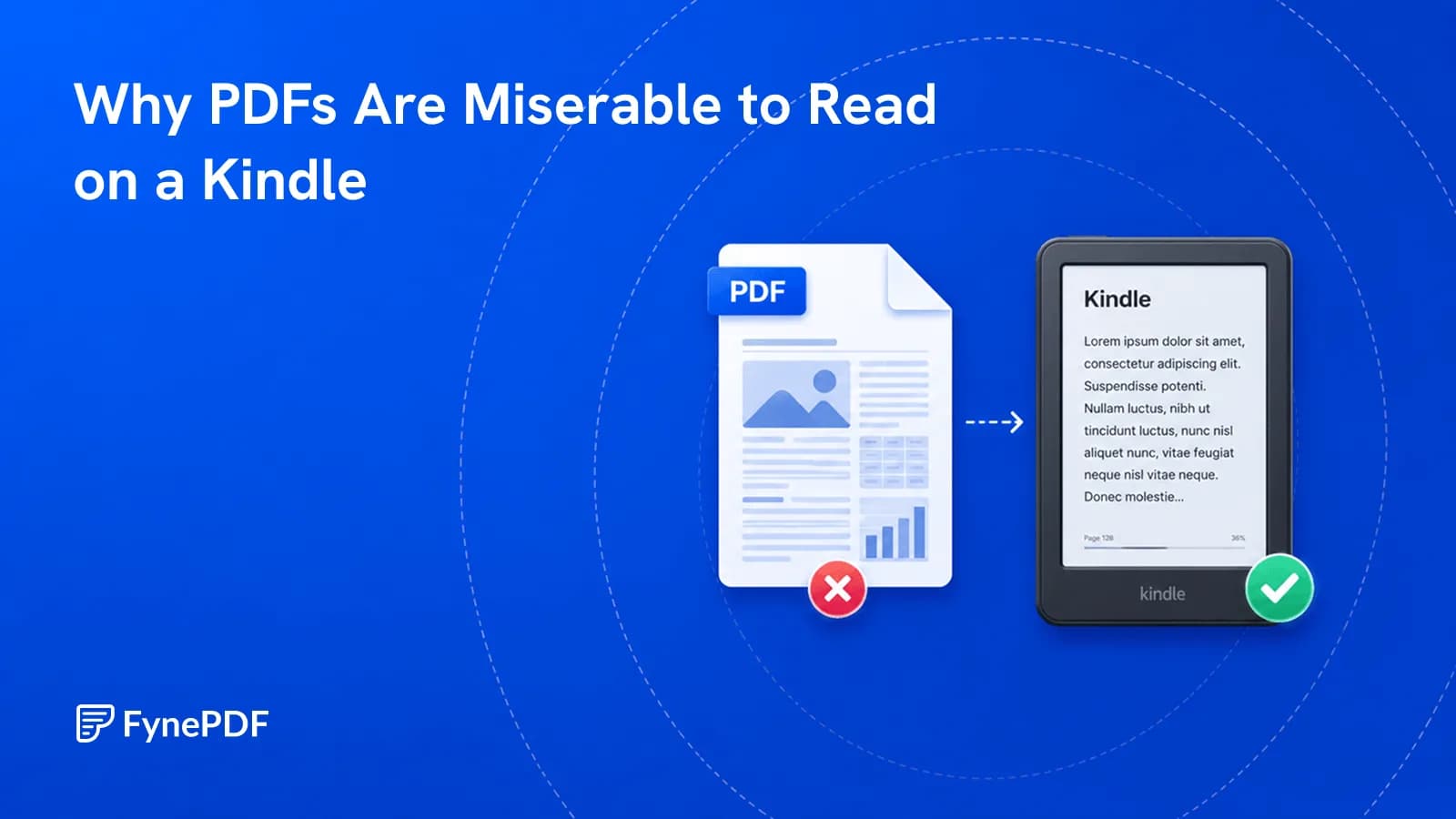
Why PDFs Are Miserable to Read on a Kindle
PDFs have fixed pages. E-readers want text that reflows to the screen.

28 July 2026

Your 12-page report opened as 14 on their machine. Here's why, and how to stop it.
A Word document looks different on another machine because Word links to fonts rather than embedding them, and reflows text to fit whatever is available. If the recipient lacks your font, a substitute changes every line break, which changes every page break. Converting to PDF fixes the layout permanently.
The document you send and the document they open are, in a real sense, two different files.
Fonts first, and everything else follows from that. Word stores a font name, not the font itself. Open the file on a machine without that font and the system picks a replacement, one with different letter widths. Slightly wider characters push the last word of each line onto the next line. Do that across a page and you gain a line; across ten pages you gain a page.
Once pagination shifts, everything anchored to it moves too. Headings that sat at the top of a page drift to the bottom of the previous one. Images float away from the paragraphs they illustrate. Tables split across page boundaries. A table of contents lists page numbers that no longer correspond to anything.
Margins and paper size add a second layer. A document set to A4 opened on a system defaulting to Letter reflows again, because the printable area is a different shape.
| Document type | Risk |
|---|---|
| Plain text report, common font | Low |
| Anything using a licensed or brand font | High |
| Documents with a table of contents | High, page numbers desync |
| Heavy use of images and text wrapping | High |
| Tables near page boundaries | High |
| Templates from another organisation | High, often carry unusual fonts |
Anything you didn't author yourself is worth checking. Corporate templates frequently specify a brand font that exists only on machines inside that company.
.docx.Free accounts handle files up to 100MB here, which covers essentially any document that isn't packed with high-resolution images.
That fourth step catches the one failure worth catching. If your 12-page document converts to 14, something reflowed during conversion, and it's better to find that now than after a client does.
For anything final, yes. Contracts, proposals, reports, applications, invoices, CVs. These are documents where you need the recipient to see what you laid out.
Send Word files when the recipient needs to edit. Collaborative drafts, documents going through review, templates people will adapt. Sending a PDF to someone who needs to make changes just means they'll convert it back, and PDF to Word conversions introduce their own layout problems.
The practical rule: Word for work in progress, PDF for anything finished.
The shift happened before conversion, on your own machine, and got baked in. This occurs when the file was created elsewhere and already reflowed when you opened it. You converted what you saw, not what the author intended.
Two ways to catch it:
If the source is a template from another organisation, ask them for a PDF instead of a .docx. It's a smaller favour than reconstructing their layout.
Converting usually reduces it, sometimes substantially, because Word files carry revision history, embedded thumbnails, and formatting data the PDF doesn't need.
Image-heavy documents are the exception and can stay large. If the result is too big for email. Gmail caps attachments at 25MB, Outlook desktop at 20MB. Run Compress PDF afterwards. Photographs inserted at full camera resolution are almost always the cause, and they compress heavily.
Yes. PDFs embed the fonts they use, which is the entire mechanism by which the layout stays fixed. That's why a PDF looks identical on every device and a Word file doesn't.
Keep the .docx as your working master and treat the PDF as the output. Converting back with PDF to Word works, but every round trip degrades the structure, so it's a recovery route rather than a workflow.
Resolve or remove them before converting. Depending on the source settings they may appear in the output, and a proposal reaching a client with internal review comments attached is an avoidable problem.
Files transfer over encrypted connections and are permanently deleted within 15 minutes of processing unless you save them to your library.
Upload your file to Word to PDF and compare the page count before sending. What you see is then what they see.
Try it yourself
PDFs have fixed pages. E-readers want text that reflows to the screen.
It renders beautifully on GitHub and reads as plain text everywhere else. Convert it.
Ctrl+P captures cookie banners and misses images. Here's how to archive a page properly.