fynepdf logo

URL to PDF

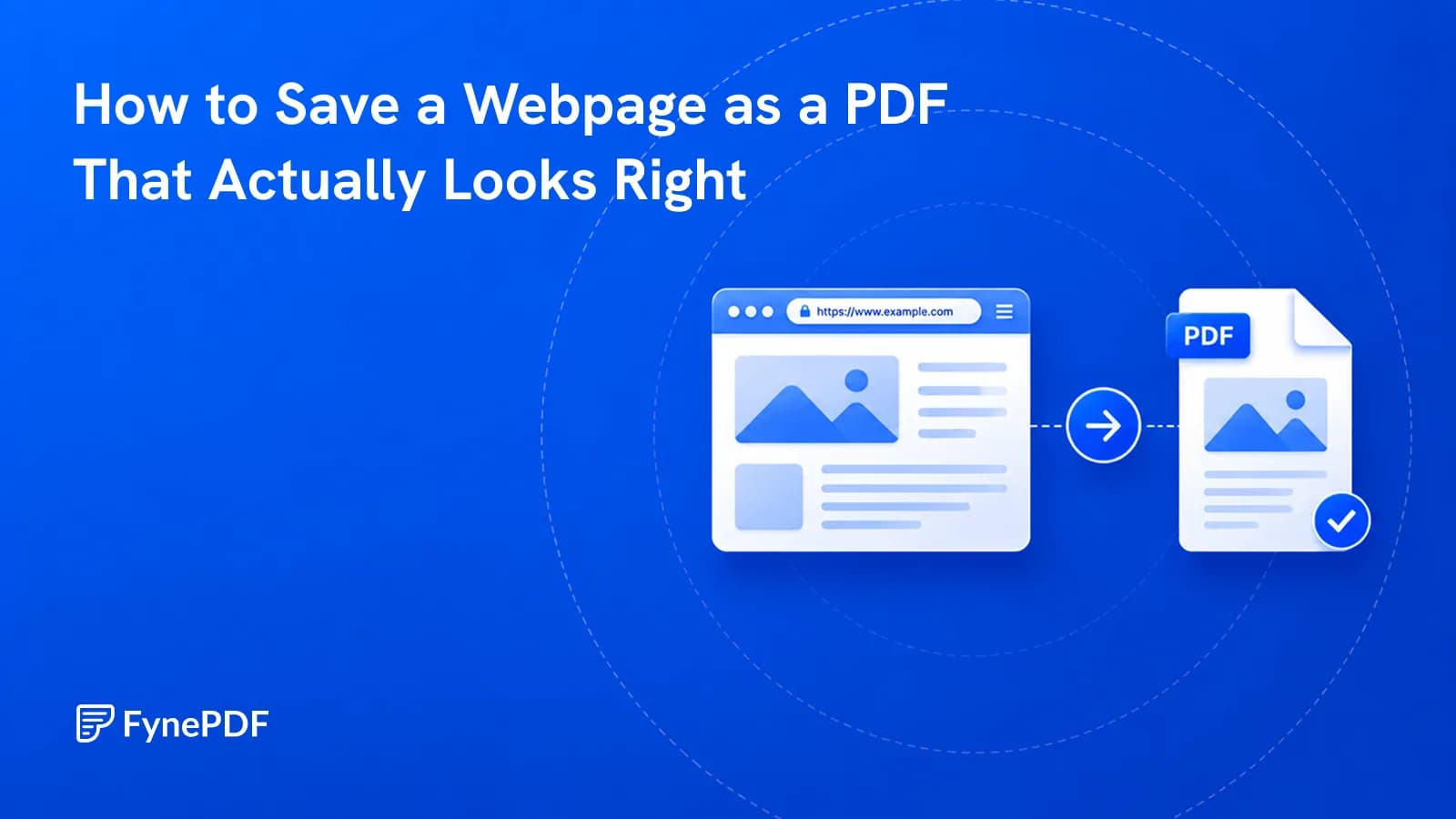
Save any web page as a PDF.

  • Convert Webpages & HTML to PDF

  • No Watermark on Downloads

  • Full JavaScript rendering

URL to PDF

Save any web page as a PDF.

File upload

Convert Webpages & HTML to PDF

No Watermark on Downloads

Full JavaScript rendering

Webpage to PDF

Capture a live page or upload an .html file, CSS, fonts and images all render.

Responsive Device Views

Render the page at desktop, tablet or mobile width, then set your page margins.

Save Job Ads and Listings

Capture job posts, rentals or product pages before they're edited or removed.

Save a Webpage as PDF in Three Steps

Save a web page as a PDF in three steps, no software to install, no account needed.

1

Enter URL or Upload HTML

Paste a webpage URL, or upload a local .html file. Free plans cover 5 sites per day.

2

Choose your device screen

Pick desktop, tablet or mobile view, and choose no, small or large page margins.

3

Download the Result

Your PDF capture of the webpage is ready to download and auto-deleted after 15 min.

Capture, Share, and Archive the Web.

Websites change constantly and links go dead. Here is how turning dynamic web pages into static PDFs preserves digital content forever.

Web Design Handoffs

Upload local .html files and render them in desktop or mobile view to present responsive design progress to clients without hosting.

Capture Legal Evidence

Securely document terms of service, public statements, or website copy as it appeared on a specific date for legal proceedings.

Save Digital Receipts

Save accessible web invoices and confirmations as PDFs for your records. Pages requiring a sign-in may need to be downloaded from the original site.

Comfortable Offline Reading

Render long-form articles or documentation using the 'Mobile' view to create a PDF you can read offline on your phone.

Archive Competitor Activity

Websites change daily. Capture an offline PDF snapshot of a competitor's live landing page or pricing table before they update it.

Share Dashboard Reports

Save a dashboard's page as HTML, upload it, and turn live reporting into a clean PDF for stakeholders.

What gets captured

FynePDF loads the page in a real browser, waits for it to finish rendering, and prints the result to PDF, so scripts run, images load and CSS applies exactly as they would for a visitor. What you get is the page as it appeared at that moment, not a raw HTML dump.

The full page

The whole page is captured top to bottom, not just what fits on screen, including content below the fold.

Your chosen width

Desktop, tablet or mobile viewport. Responsive sites lay out differently at each, and the PDF reflects that.

Static, not interactive

Links stay clickable, but menus, forms, video and anything needing a click become fixed images of themselves.
Frequently Asked Questions

Can I convert any website to PDF? What about password-protected pages?

Any publicly accessible web page can be converted, paste the URL and FynePDF loads it in a real browser, waits for scripts and images to finish, then captures the result. Pages behind a login can't be reached this way, since the tool visits them as an anonymous visitor. For those, save the page from your own browser (File โ†’ Save Page As) and upload the .html file instead.

Will the PDF look exactly like the website? What about responsive design?

The PDF matches the page as rendered at the viewport you choose. Select desktop, tablet or mobile, and responsive sites lay out accordingly, a mobile capture produces the narrow single-column version, which is often more readable as a PDF than the desktop layout. Backgrounds, colours and images are preserved. Interactive elements become static: links stay clickable, but menus, forms and video are captured as they appear.

Is the URL to PDF tool free to use online?

Yes, FynePDF's URL to PDF tool is free with no sign-up required. Free accounts capture 5 sites, and Professional at $7/month removes the limit entirely along respectively.

Is it safe to use URL to PDF on FynePDF? Are my files secure?

File transfers use TLS encryption. Cloud-processed files are automatically deleted within 15 minutes after processing completes, unless you choose to save them to your Library. Documents are not used to train AI models. Read the Privacy Policy for storage and processing details.

Can I use the URL to PDF tool on Mac, Windows, or mobile?

Yes. FynePDF works directly from your browser, so it works on Windows, Mac, Linux, iOS and Android with no installation. Capturing a web page as a proper PDF from a phone is awkward otherwise, so this is often more useful on mobile than desktop.

How do I save a web page as PDF for legal evidence?

Capture the page as soon as possible, since sites change without notice, and keep a record of the exact URL and the date and time you captured it. FynePDF renders the page as it appeared at that moment, including content loaded by scripts, which a raw HTML save can miss. For contested matters, courts generally expect provenance, the source URL and a timestamp so record those alongside the file.

Why does my PDF look different from the live page?

Three usual causes. Cookie and consent banners appear in the capture because they're part of the page for a first-time visitor. Content that loads only as you scroll may not have appeared before the capture completed. And sites that behave differently by location or login state show you a different page than they show our renderer. If a banner is in the way, try capturing the page's print view or saving it from your own browser as HTML and uploading that instead.

Can I capture a page that needs a login?

Not by URL, since FynePDF visits the page as an anonymous visitor and sees the login screen instead. The workaround is to open the page while logged in, save it from your browser (File โ†’ Save Page As, complete web page), and upload the .html file. That captures exactly what you were looking at, including account dashboards, order histories and internal reporting tools.

What's the difference between this and Chrome's Print to PDF?

Chrome prints the page at your current window width and drops background colours and images unless you enable them. FynePDF renders at a viewport you choose, including mobile, which a desktop browser can't produce keeps backgrounds by default, and captures the full page rather than paginating whatever is on screen. It also works from a phone, where saving a proper PDF is otherwise awkward. For a quick personal copy, Chrome is fine; for anything you're archiving, sharing or relying on later, a controlled capture is more predictable.