fynepdf logo

PDF to PDF/A

Convert to ISO-standard PDF/A for long-term archiving.

  • Convert to PDF/A (ISO Standard)

  • No Watermark on Downloads

  • Four conformance levels

PDF to PDF/A

Convert to ISO-standard PDF/A for long-term archiving.

or drop your file here

File upload

Convert to PDF/A (ISO Standard)

No Watermark on Downloads

Four conformance levels

Advanced Export Options

Choose the exact ISO standard you need to meet strict institutional requirements.

Long-Term Preservation

All fonts are embedded, so the file renders identically decades from now.

Archive Scans as PDF/A

Run OCR PDF first so archived scans stay searchable for years to come.

Three Steps to an Archive-Ready PDF

Convert to PDF/A in three steps, no software to install, no account needed.

1

Upload your PDF

Drag and drop or select your document up to 100MB free, 1GB on Pro and 5GB on Premium.

2

Select your PDF/A standard

Pick PDF/A-1a, 2b, 3b or 4. Fonts are embedded and non-archival features are removed.

3

Download the Result

Your newly validated, ISO-compliant PDF/A is ready to download and auto-deleted after 15 min.

Future-Proof Your Most Important Documents.

Standard PDFs can break or lose formatting as software evolves. Here is why converting to PDF/A is essential for long-term storage and compliance.

Legal & Court Filings

Prepare legal records in an archival PDF format. Check the recipient's required PDF/A version and validate the file before submission.

Government Compliance

Government agencies require PDF/A-1a to ensure archived public records meet strict long-term preservation and accessibility laws.

Corporate Archiving

Future-proof your company's financial records and HR files so they can be opened on any software decades from now.

Medical Records Storage

Securely archive patient histories, lab results, and medical reports in a standardized format that meets healthcare compliance guidelines.

Embedding Data (PDF/A-3b)

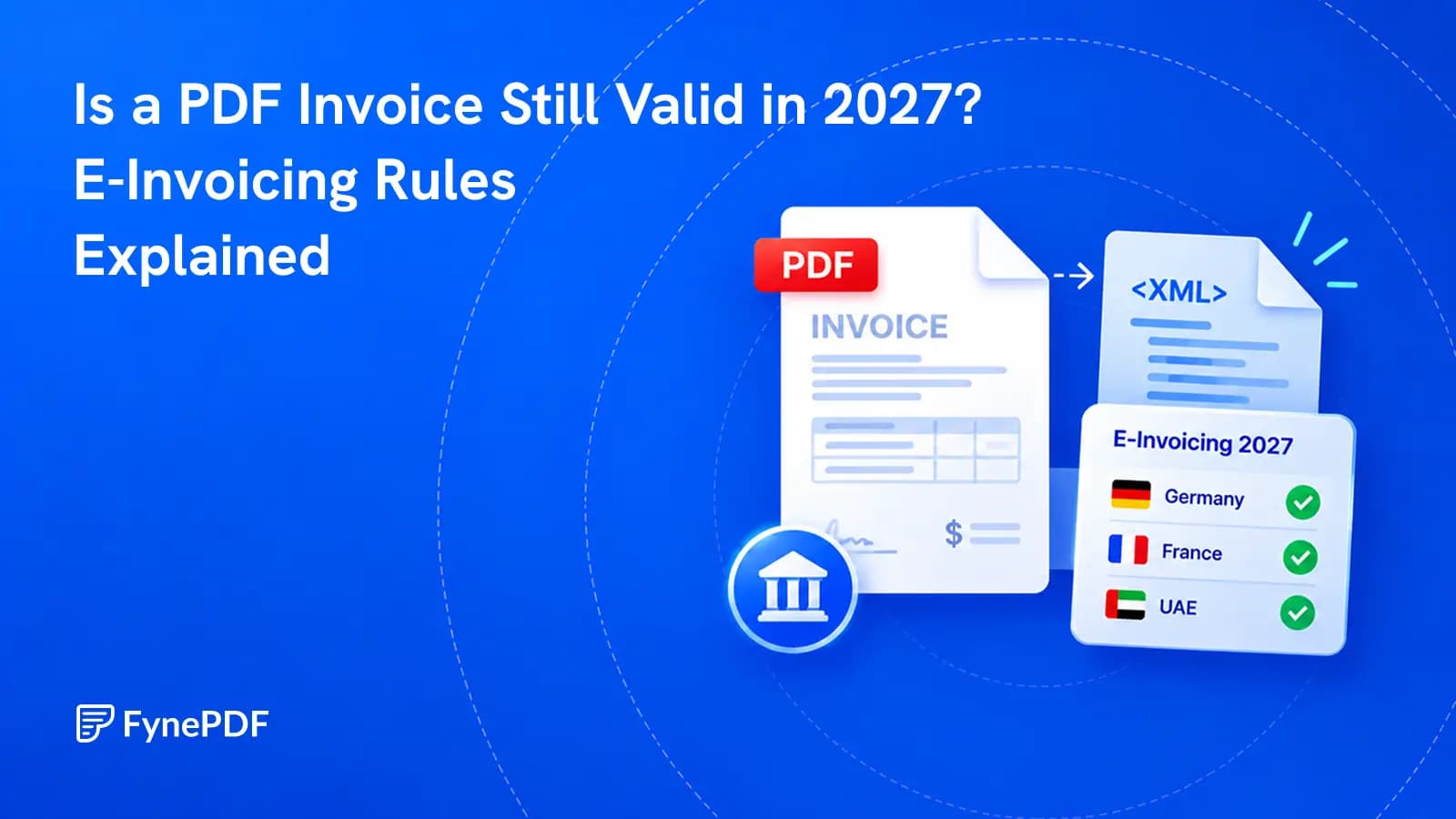
Use the PDF/A-3b standard to securely attach raw, machine-readable data like XML or CSV files inside your visual billing invoices.

Library & Academic Preservation

Ensure university research papers, digitized historical books, and thesis files remain accessible for future generations of scholars.

Which PDF/A level do you need?

PDF/A comes in several conformance levels, and institutions usually specify exactly one. If you've been given a requirement, match it. If you're choosing for yourself, the differences come down to how old the receiving system is and what your document contains.

PDF/A-1a

The accessibility level. Requires full document tagging and structure, and it's what public-sector accessibility rules usually mandate.

PDF/A-2b and 3b

2b adds transparency, layers and JPEG2000. 3b additionally allows embedded files, so an invoice can carry its own XML.

PDF/A-4

The newest level, based on PDF 2.0. Choose it when the receiving system supports it; otherwise an earlier level is safer.
Frequently Asked Questions

What is PDF/A and why would I need it?

PDF/A is an ISO-standardised version of PDF built for long-term archiving. It embeds every font in the file, forbids features that could stop it opening later encryption, external references, JavaScript and requires colour information to be self-contained. The result is a document that renders identically decades from now on software that doesn't exist yet. Courts, government agencies, journals and records departments frequently require it for exactly that reason.

Which PDF/A compliance level should I choose?

FynePDF offers PDF/A-1a, 2b, 3b and 4. If an institution has specified a level, use that one requirement is usually exact. PDF/A-1a is the accessibility level and requires tagged document structure, which is what many public-sector rules mandate. PDF/A-2b adds support for transparency, layers and JPEG2000 compression. PDF/A-3b allows other files to be embedded inside the PDF, which is how e-invoicing standards attach machine-readable XML. PDF/A-4 is the newest, based on PDF 2.0, choose it when you know the receiving system supports it.

Is the PDF to PDF/A tool free to use online?

Yes, FynePDF's PDF to PDF/A tool is free with no sign-up required. Free accounts can convert files up to 100MB, with up to 10 tasks and 600MB of processing a day. Professional at $7/month raises this to 1GB, and Premium to 5GB.

Is it safe to use PDF to PDF/A on FynePDF? Are my files secure?

File transfers use TLS encryption. Cloud-processed files are automatically deleted within 15 minutes after processing completes, unless you choose to save them to your Library. Documents are not used to train AI models. Read the Privacy Policy for storage and processing details.

Can I use the PDF to PDF/A tool on Mac, Windows, or mobile?

Yes. FynePDF works directly from your browser, so it works on Windows, Mac, Linux, iOS and Android with no installation. Chrome, Firefox, Safari and Edge are all supported.

What does "Allow Image Downgrade for Compliance" do?

Some images can't be carried into PDF/A in their original form, unsupported colour spaces or compression types, most commonly. With this option ticked, those images are re-encoded into a compliant format, which may slightly reduce their quality but lets the file validate. Left unticked, conversion will fail rather than alter your images. Tick it when the priority is meeting a submission requirement; leave it off when image fidelity matters more than compliance.

How do I check my file is genuinely PDF/A compliant?

Open it in Adobe Acrobat, which displays a PDF/A banner and can run a full preflight check, or use veraPDF, the open-source validator maintained by the PDF Association and used by national archives. Both report the specific conformance level and any errors. If you're submitting to a court or repository that runs its own validation, checking first is worth the two minutes.

Will my PDF look different after converting to PDF/A?

Visually it should look the same. Conversion embeds fonts, converts colours to self-contained profiles and removes features PDF/A forbids, encryption, JavaScript, embedded video and links to external files. If your document relied on any of those, that functionality is gone, but the pages themselves render as before. Files usually get slightly larger because fonts that were previously referenced are now embedded.

Does converting to PDF/A remove password protection?

Yes, necessarily. PDF/A forbids encryption entirely, because a password is exactly the kind of thing that stops a file opening decades later. If your source PDF is protected, unlock it first. Bear in mind that an archived PDF/A file can't then be re-protected without breaking compliance, protect a separate copy if you need both.