


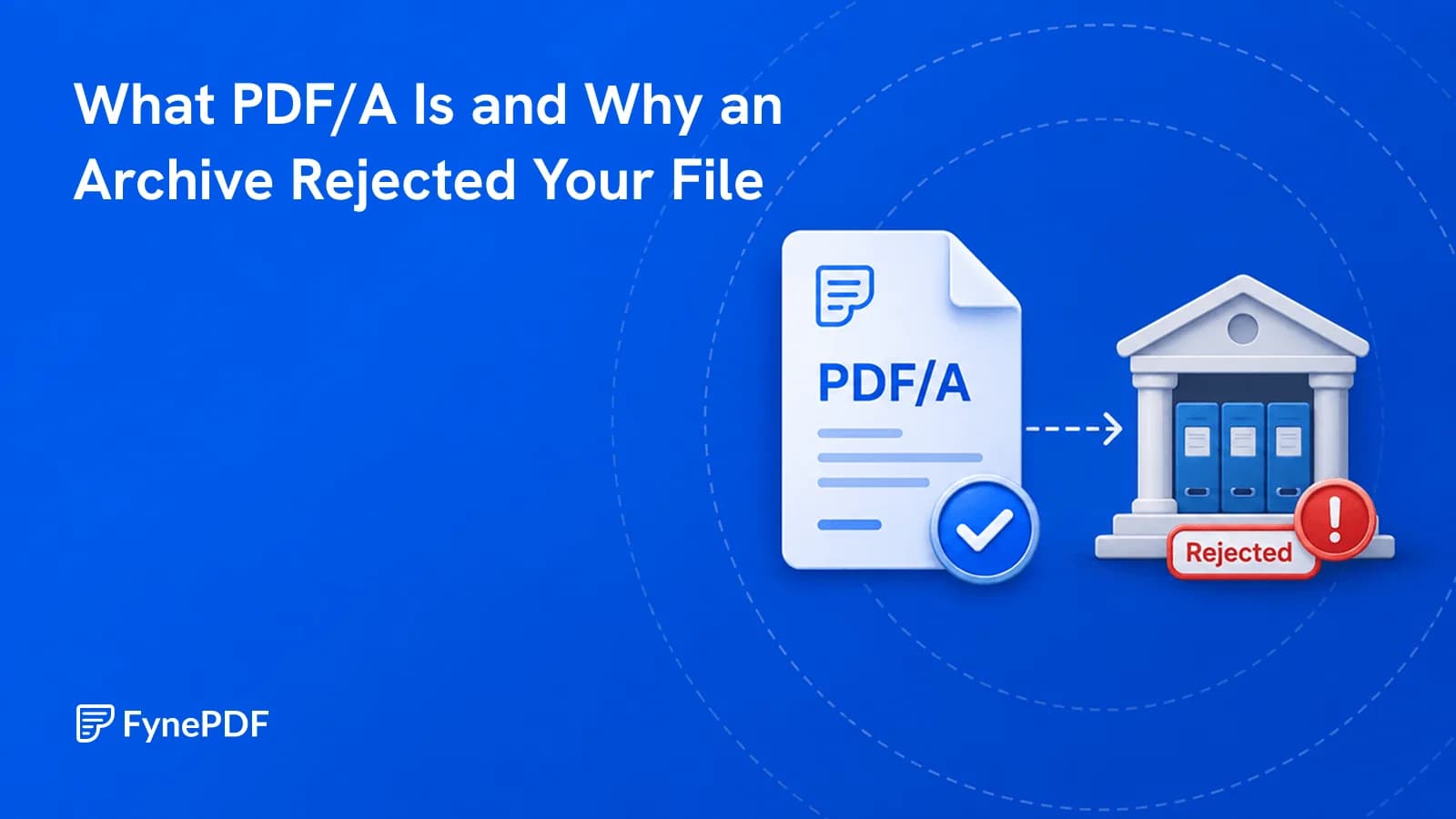
What PDF/A Is and Why an Archive Rejected Your File
Courts, journals and archives require it because ordinary PDFs can depend on external things.

20 September 2026
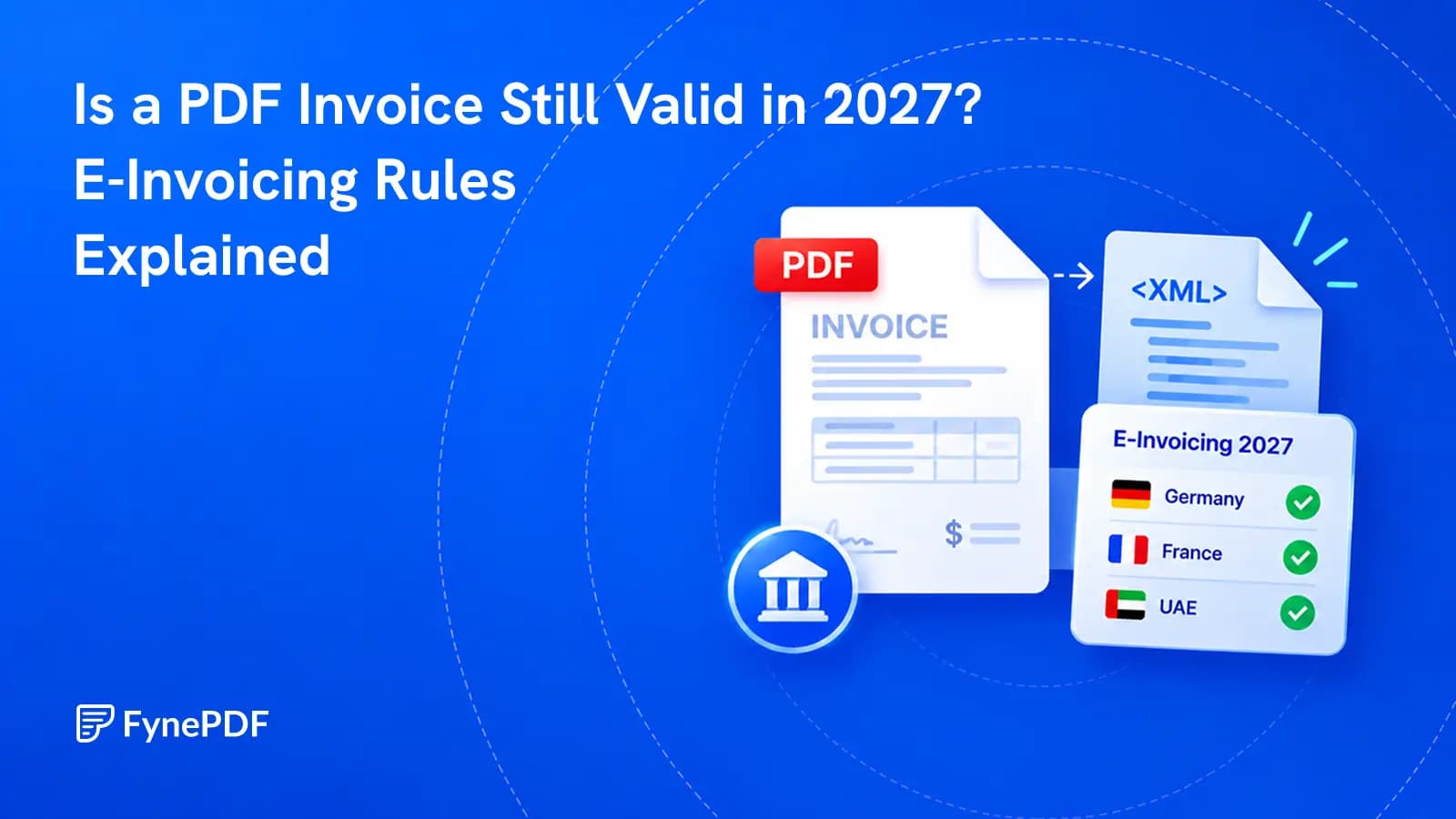
A PDF can still be readable and legally useful while failing a new e-invoicing requirement. The difference is structured data.
A PDF invoice can still be valid in 2027, but an ordinary PDF may no longer meet the e-invoicing rules that apply to your business. Germany, France, and the United Arab Emirates are moving covered business invoices into structured systems that accounting software can process automatically.
The important question is no longer simply, “Can my customer open this invoice?” It is, “Does the invoice contain structured data, and was it sent through the required system?”
A PDF attached to an email may look correct to both sender and buyer. That does not automatically make it a compliant e-invoice.
An ordinary PDF invoice is made for people to read. It displays the seller, buyer, invoice number, line items, tax, and total in a fixed layout.
An e-invoice carries the same information in a structured format that software can read without someone copying each field by hand.
The European Commission’s definition of an e-invoice requires structured data that allows automatic electronic processing. It specifically separates e-invoices from unstructured PDF files, Word documents, scans, and images.
| Format | Human-readable | Machine-readable | Usually counts as an e-invoice |
|---|---|---|---|
| PDF attached to an email | Yes | Not in a reliable structured form | No |
| Scanned paper invoice | Yes | No, unless data is extracted separately | No |
| XML invoice | Not easily | Yes | Yes, when it follows the required standard |
| Factur-X or ZUGFeRD | Yes | Yes | Yes, when the correct profile and data are used |
| PDF/A-3 without valid invoice XML | Yes | Not necessarily | No |
This distinction matters because saving a Word invoice as PDF changes its appearance and file format. It does not turn the invoice into structured accounting data.
Sometimes, but the answer depends on the seller’s turnover, the type of transaction, and whether an exception applies.
Germany introduced its domestic business-to-business e-invoicing framework on January 1, 2025. Since that date, businesses established in Germany have generally needed to be able to receive e-invoices.
The timetable for issuing them is gradual:
| Period | What happens |
|---|---|
| 2025 and 2026 | Businesses can still issue paper invoices or, with the recipient’s agreement, ordinary electronic invoices such as emailed PDFs |
| From January 1, 2027 | Businesses with previous-year turnover above €800,000 generally lose that transition and must issue e-invoices for covered domestic B2B transactions |
| During 2027 | Businesses with previous-year turnover of €800,000 or less can continue using the transition |
| From January 1, 2028 | The broad transition ends and covered domestic B2B invoices generally need to be e-invoices |
These dates come from the German Federal Ministry of Finance’s e-invoicing guidance.
A simple PDF does not meet Germany’s definition of an e-invoice because it does not contain structured invoice data. Common compliant formats include XRechnung and qualifying ZUGFeRD profiles.
That does not mean every PDF invoice in Germany becomes unlawful on January 1, 2027. The mandate does not apply in exactly the same way to every transaction. The ministry lists exceptions that include certain invoices of €250 or less, transport tickets, invoices issued by small-business taxpayers under the relevant German scheme, many tax-exempt supplies, and invoices to consumers.
The practical result is more precise than the headline:
For an in-scope domestic B2B sale, a large German supplier should not rely on an ordinary PDF invoice in 2027. A smaller supplier may still fall within the transition until the end of that year.
France began its phased rollout on September 1, 2026.
From that date:
The rules primarily concern domestic transactions between businesses established in France and subject to VAT. The treatment of exempt, international, and consumer transactions can be different.
The French Ministry for the Economy and Finance states that a scanned invoice, an ordinary PDF, or a document sent by email will not satisfy the new system for transactions within its scope.
Covered invoices must use a standard electronic form and pass through a platform accredited by the French government, either directly or through compatible invoicing software.
France’s minimum supported formats include:
The French rules make an important point for small businesses. Even a business that does not charge VAT because it uses the basic VAT exemption can still be considered subject to VAT for the purpose of the reform. It may therefore need to receive and later issue electronic invoices according to the timetable.
By September 1, 2027, a small French business should not assume that emailing its usual PDF will satisfy the requirement. It needs to confirm that its accounting software or chosen accredited platform can create and transmit the required invoice data.
An ordinary PDF is not an e-invoice under the UAE system.
The UAE Ministry of Finance e-invoicing portal says this directly. PDF files, Word documents, images, scanned copies, and emails are unstructured formats and are not e-invoices.
Mandatory implementation is being introduced in stages:
| Business or entity | Required implementation date |
|---|---|
| Businesses with annual revenue of at least AED 50 million | January 1, 2027 |
| Businesses with annual revenue below AED 50 million | July 1, 2027 |
| In-scope government entities | October 1, 2027 |
The larger businesses were required to appoint an accredited service provider by July 31, 2026. Businesses below the AED 50 million threshold must appoint one by March 31, 2027.
The full schedule and scope are explained in the UAE Ministry of Finance implementation announcement.
The UAE system covers in-scope business-to-business and business-to-government transactions, subject to specified exclusions. Businesses use an accredited service provider to exchange structured invoice data. The system uses the Peppol framework and the UAE’s PINT AE data model.
A supplier can still create a PDF for a person to read, but sending that file alone does not complete the required e-invoicing process.
Yes. A PDF can remain part of the invoice when it is used in a hybrid format.
Factur-X and ZUGFeRD combine two parts:
The Forum for Electronic Invoicing Germany describes ZUGFeRD and Factur-X as hybrid formats built around PDF/A-3 and structured invoice data.
This is why saying “PDF invoices are being banned” is misleading. The readable PDF can survive. What is disappearing from many regulated transactions is the plain, unstructured PDF sent by itself.
The structured data is not a minor attachment. It is the part that allows the invoice to be validated, exchanged, imported, and reported. In Germany, if the readable part of a hybrid invoice conflicts with its structured data, the structured part is generally treated as the leading invoice record.
No.
PDF/A-3 is a container capable of holding other files, including XML. Converting a PDF to PDF/A-3 does not automatically:
You can use PDF to PDF/A when you need an archival PDF or a PDF/A version of an invoice. That conversion alone should not be presented as regulatory e-invoicing compliance.
A compliant hybrid invoice normally needs to be created by accounting or invoicing software that understands the relevant standard and can validate the structured data.
Start with the transaction, not the file.
Your accountant, tax adviser, or invoicing software provider should confirm how the rules apply to your business. This article is a practical overview, not jurisdiction-specific tax advice.
Emailing a digital file is not the same as exchanging a structured e-invoice. The method is electronic, but the invoice data remains unstructured.
Selectable text can help with copying or extraction, but it does not give each value a defined accounting meaning. Software may see “20%” without knowing whether it is a tax rate, a discount, or part of a product description.
OCR can recover words from a scan. It does not create a standards-compliant invoice structure or submit the invoice through the required network.
PDF/A supports long-term preservation. PDF/A-3 can also hold attachments. Neither fact proves that a valid invoice XML file exists inside the document.
A signature can support authenticity and integrity. It does not replace the structured fields, platform, or reporting process required by an e-invoicing mandate.
No. Ordinary PDFs may remain valid for transactions outside a mandate, during a transition, or under an exception. The rules depend on the country, transaction, seller, buyer, turnover, and tax treatment.
Often, yes. A readable copy can help the recipient review the invoice. It should not replace the structured invoice where one is required, and its totals and details must not conflict with the structured record.
No. Factur-X uses a readable PDF/A-3 document, but it also contains structured XML invoice data. The XML is what makes automatic processing possible.
Possibly. Some existing systems can connect to an accredited provider or add compliant e-invoicing support. Others may need an upgrade or replacement. Ask whether the system can create, validate, send, receive, and preserve the required structured format.
Domestic B2B mandates do not always cover cross-border transactions in the same way. Separate electronic reporting requirements may still apply. Check the rules for both the seller’s and buyer’s locations.
Keep any readable copy that supports your normal records, but do not discard the original structured invoice. In a hybrid invoice, preserve the complete file with its embedded data.
A polished invoice can still fail an e-invoicing rule. The deciding factor is not how professional the PDF looks. It is whether the invoice carries valid structured data and moves through the required system.
If you need a long-term visual copy, you can prepare it with PDF to PDF/A. For the regulated invoice itself, use accounting software or an accredited provider that supports the correct format for your country.
Try it yourself
Courts, journals and archives require it because ordinary PDFs can depend on external things.

Your 12-page report opened as 14 on their machine. Here's why, and how to stop it.
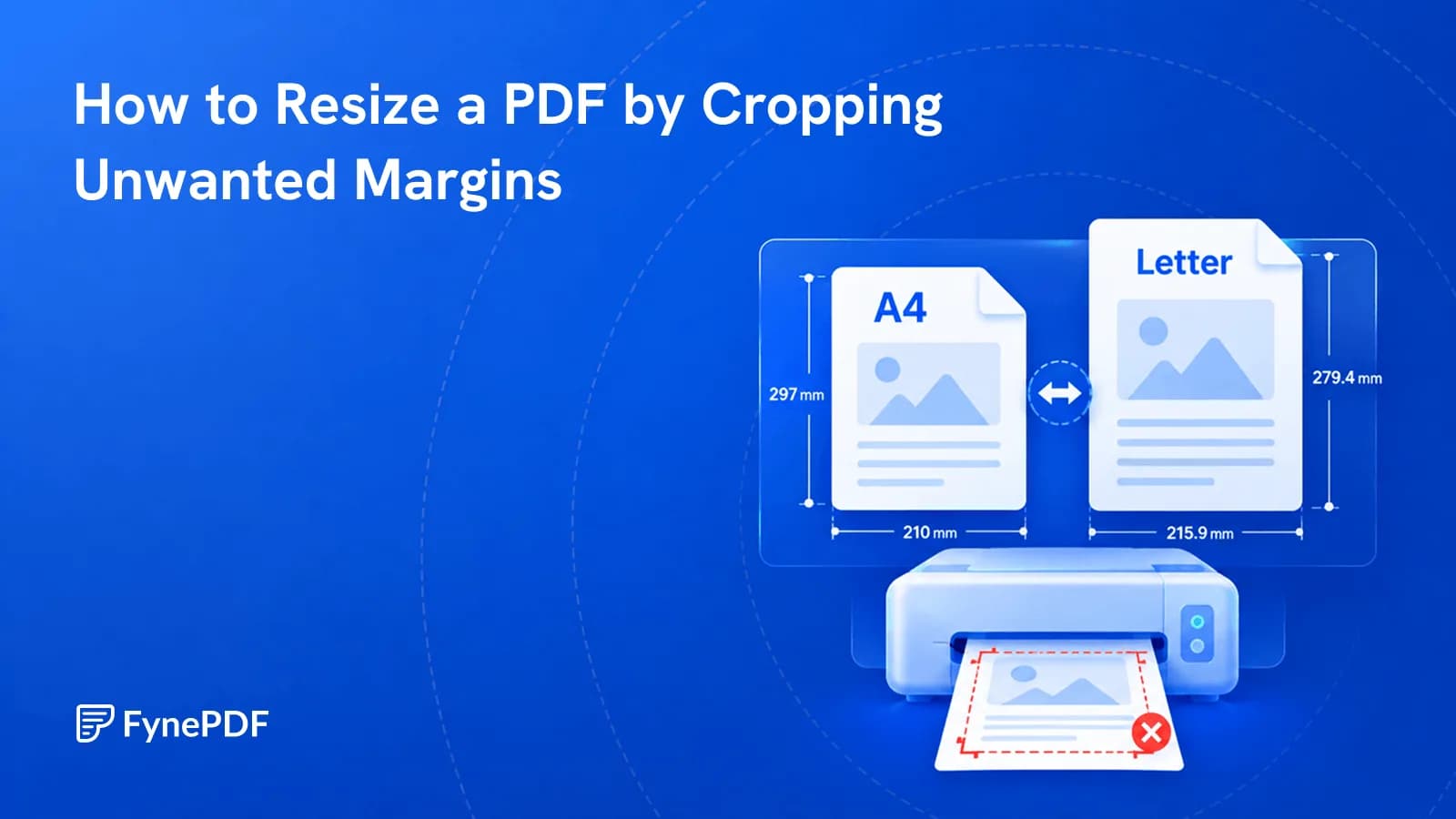
Cropping removes unnecessary margins so your PDF fits the page better when printing or sharing.