fynepdf logo
ToS / Privacy Policy TL;DR

ToS / Privacy Policy TL;DR

Turn terms of service and privacy policies into a plain-English summary.

Find Hidden Red Flags

Supports PDF, TXT and more

You“Can they sell my data?”
AI AvatarFyne Bot“Section 6 allows sharing with
selected third parties…”

or drop your file here

File upload

Understand What You're Signing in 3 Steps

Find data practices, renewal terms, and rights described in the document.
Upload or Paste
Upload or Paste

Paste the text straight in, or upload a PDF or .txt. No account needed.
AI Extraction
AI Extraction

The agent flags auto-renewals, risky clauses and data selling.
Get the TL;DR
Get the TL;DR

Read the simplified plain summary, ask specific questions and export the notes.

Read the Terms That Matter

Understand data use, content rights, and dispute terms.

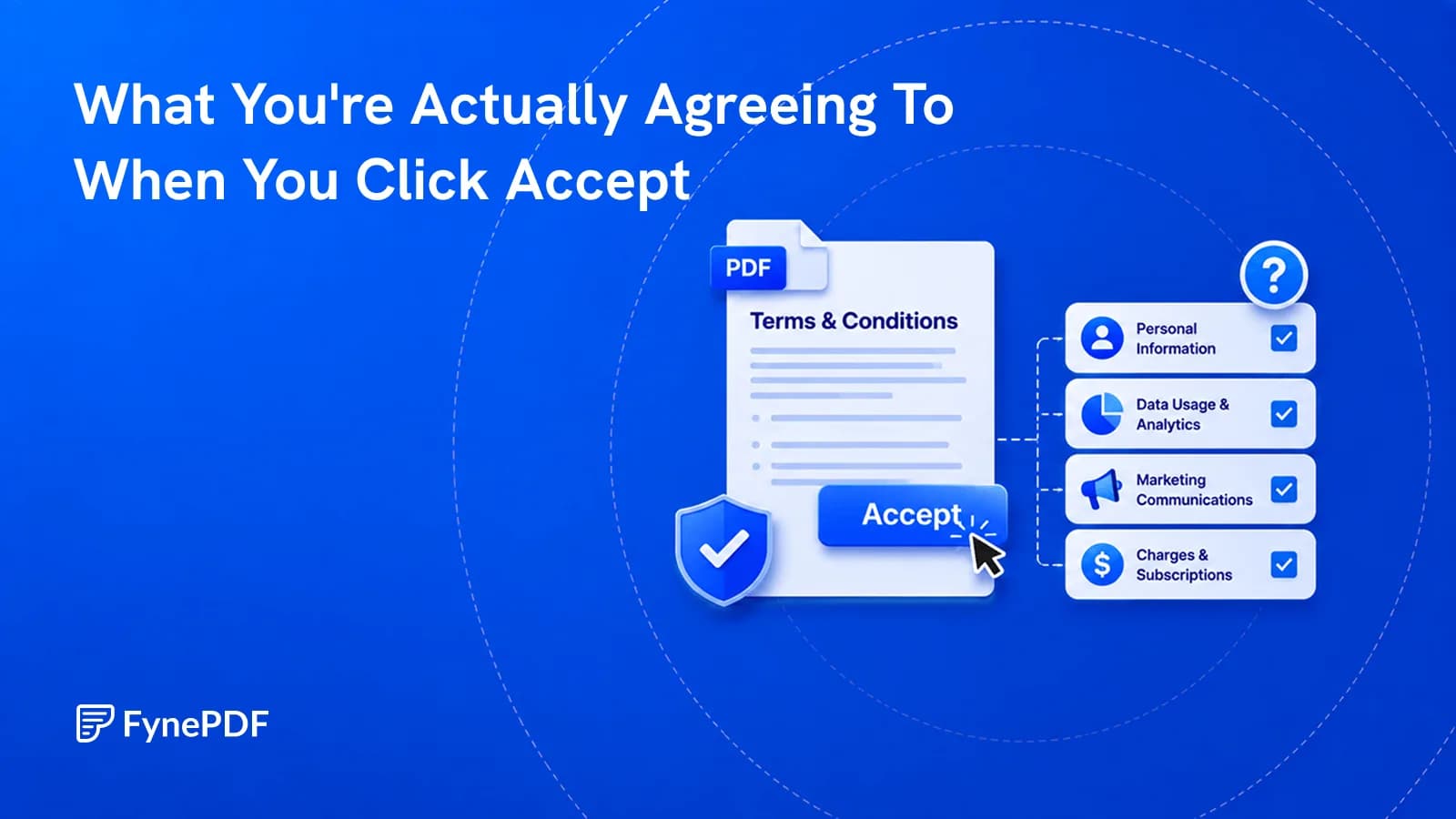
Summarize terms of service or a privacy policy from your PDF. Ask about data sharing, account rights, renewals, or arbitration, then read the original clauses behind the explanation before accepting an agreement.

Review Data Use

Find collection and sharing terms.

Check Content Rights

See what rights the policy claims.

Explain Policy Terms

Get a clear summary of dense wording.

file-icon
SocialApp_Privacy_2026.pdfLast Updated: Today
What happens to my data if I delete my account?
AIBased on Section 4.5, deleting your account does not immediately erase your personal information. Here is the breakdown:
Legal Text (Complex)We may retain residual copies of your User Content and Personal Data for up to 90 days in our backup systems, and indefinitely for anonymized analytics.
TL;DR Summary (Clear)They keep your private data for 3 months after deletion, and they keep your “anonymized” behavior data forever.
p.4Copy

Know what the policy asks you to accept.

Review data use, renewal terms, and dispute clauses in clear, cited explanations.

Data Use and Rights

Ask how a privacy policy describes data collection, sharing, and retention. Find the terms that affect your information and account rights.

Renewal and Liability

Review auto-renewal, liability limits, and dispute clauses. Ask what each term means and where the agreement places obligations on you.

Prioritize Concerns

Read findings grouped by level of concern. Focus on the policy terms that deserve closer attention and check their wording in the PDF.

Explain, Summarize, Ask

Select text in your PDF to explain a term, summarize a passage, or ask a question. Explore the detail you need without retyping it into chat.

Highlighted Sources

Click a page citation to open your PDF at the source. When a text match is found, the passage is highlighted so you can check the AI answer.

Export Tables as CSV

Download tables from AI answers as CSV files. Keep the rows and columns ready for Excel, Google Sheets, or your next document analysis.

Understand the Fine Print

Review data practices, subscription terms, and rights described in a policy.

App Users

Read what a privacy policy says about data collection, tracking, and sharing. Ask focused questions and check the cited terms before signing up.

Software Buyers

Review renewal terms, service commitments, and data handling in vendor policies. Prepare questions for your purchasing or legal team.

Creators & Freelancers

Find licensing and ownership terms in a platform agreement. Ask what the document says about your content and review the original clauses.

Document Privacy

How your files are handled during and after your session.

No AI Training

Your documents are used for your session and are never used to train AI models.

Encrypted Transfers

TLS protects document transfers between your browser and FynePDF.

Auto-Deletion

Your file is deleted within 24 hours of upload, unless you save it to your Library.

Privacy Policy

Read how we handle document data and how to contact us about access, export, or deletion.

Your terms or privacy policy document is processed to answer your questions about its wording. FynePDF staff do not manually open or review your file contents.

AI features may send document content to the Google Gemini API to produce the output you request. Documents are not used to train AI models. Temporary files follow the deletion policy; saved documents follow the Library storage policy.
Read our full Security Policy.

Frequently Asked Questions

Does this replace reading the actual Terms of Service?

No, and it shouldn't. What you agree to is the binding text, not a summary of it, so for anything you're actually relying on, read the clause itself. What this does is tell you which clauses are: it reads the whole document, surfaces the terms that decide something about you, ranks them by how much they matter, and gives you the section number so you can go and read that part properly. That turns fifty pages into three paragraphs worth reading closely, which is the realistic version of "reading the terms."

Can I save the TL;DR for my records?

Three ways. Copy an individual finding straight from the chat, or download the whole session as a .txt file, both work on the free plan. Saving a session to your Library so you can reopen it later is included with Professional and Premium.

How do I check a policy that's only on a website?

Paste it. Select the text on the page, copy it, and paste it straight into the chat, no file, no upload, no account. That's the normal way to use this tool, because almost nobody has a terms of service as a PDF; they have a browser tab. If a company does publish theirs as a PDF, or you've been sent one, you can upload that instead. Either way the analysis is identical.

Can I use ToS TL;DR for free?

Yes. Read a document overview without signing in, then try one AI answer by typing a question, choosing a suggestion, or running the analysis. Each new upload gets one answer, shared across tools and agents. A paid plan unlocks further interactions within its AI allowance.

How secure are my files and data?

File transfers use TLS encryption. AI features may send document content to the Google Gemini API to generate the output you request. Documents are not used to train AI models. Temporary AI files are deleted within 24 hours of upload; files saved to your Library follow the Library storage policy. Read the Privacy Policy for details.

How do I tell if an app sells my data?

Look for what the policy does rather than what it promises. The phrases that matter are "share with third parties," "business partners," "affiliates," "advertising partners" and "for marketing purposes", a policy that says it doesn't sell your data often still shares it, and under most definitions those aren't the same thing. Check whether sharing is described as necessary to provide the service or as something the company chooses to do, and whether there's an opt-out. Paste the policy in and ask directly: "who does this share my data with, and can I stop it?" The answer will quote the section, so you can read the wording yourself rather than trusting a paraphrase.

What's a forced arbitration clause, and does it matter?

It means that if you have a dispute, you've agreed to settle it through a private arbitrator rather than in court, and it usually comes with a class-action waiver, meaning you can't join with other people affected the same way. It matters more than almost anything else in a consumer agreement, because it's the clause that determines whether you have any practical remedy when something goes wrong: individual arbitration over a $40 charge is rarely worth anyone's time, which is broadly the point of it. Some agreements include an opt-out you can exercise within 30 days of signing up, usually by email, and almost nobody does because almost nobody knows. Ask the agent whether the policy has one.

What should I actually look for in a privacy policy?

Six things, in roughly this order. How long they keep your data after you delete your account, "indefinitely for anonymized analytics" is common and means forever. Who they share it with, and whether that's necessary or commercial. Whether they can change the terms unilaterally without telling you. Whether there's a forced arbitration clause. What rights they claim over content you upload, photos, writing, code, and whether that licence survives you leaving. And whether deletion actually deletes, or just deactivates. Everything else in a typical policy is either legally required boilerplate or genuinely uninteresting.

What's an auto-renewal trap?

A subscription that renews automatically on terms less favourable than the ones you signed up on, an introductory rate that jumps at renewal, a cancellation window that closes weeks before the renewal date, or a requirement to cancel by a method that's deliberately awkward. The things to check are the notice period for cancelling, whether the price is fixed or "then-current," and whether cancelling mid-term gets you a refund or nothing. All three are usually in the billing section and all three are easy to miss because that section reads like admin.

Does this work on an app's terms, a bank's, an employer's?

Any of them. The agent reads whatever agreement you give it, app terms, a SaaS contract, a bank's account terms, a platform's creator agreement, an EULA. The analysis is the same shape each time: what you're agreeing to, what they can do with your data, what you're giving up, and what's unusual about it. For an employment contract specifically, Verify Legal Documents is built for that shape of document and will go deeper on obligations and termination.