fynepdf logo
Policy Document Summarizer

Policy Document Summarizer

Pull coverage limits, exclusions and key terms out of long policy documents.

Limits & Exclusions at a Glance

Supports PDF, TXT and more

You“What is the updated remote work policy?”
AI AvatarFyne Bot“Employees can work remotely...”

or drop your file here

File upload

Summarize Your Policy in 3 Steps

Find responsibilities, exceptions, and deadlines in your policy with cited answers.
Secure Upload
Secure Upload

Drop the employee handbook, IT policy, or regulatory PDF into our secure vault.
AI Extraction
AI Extraction

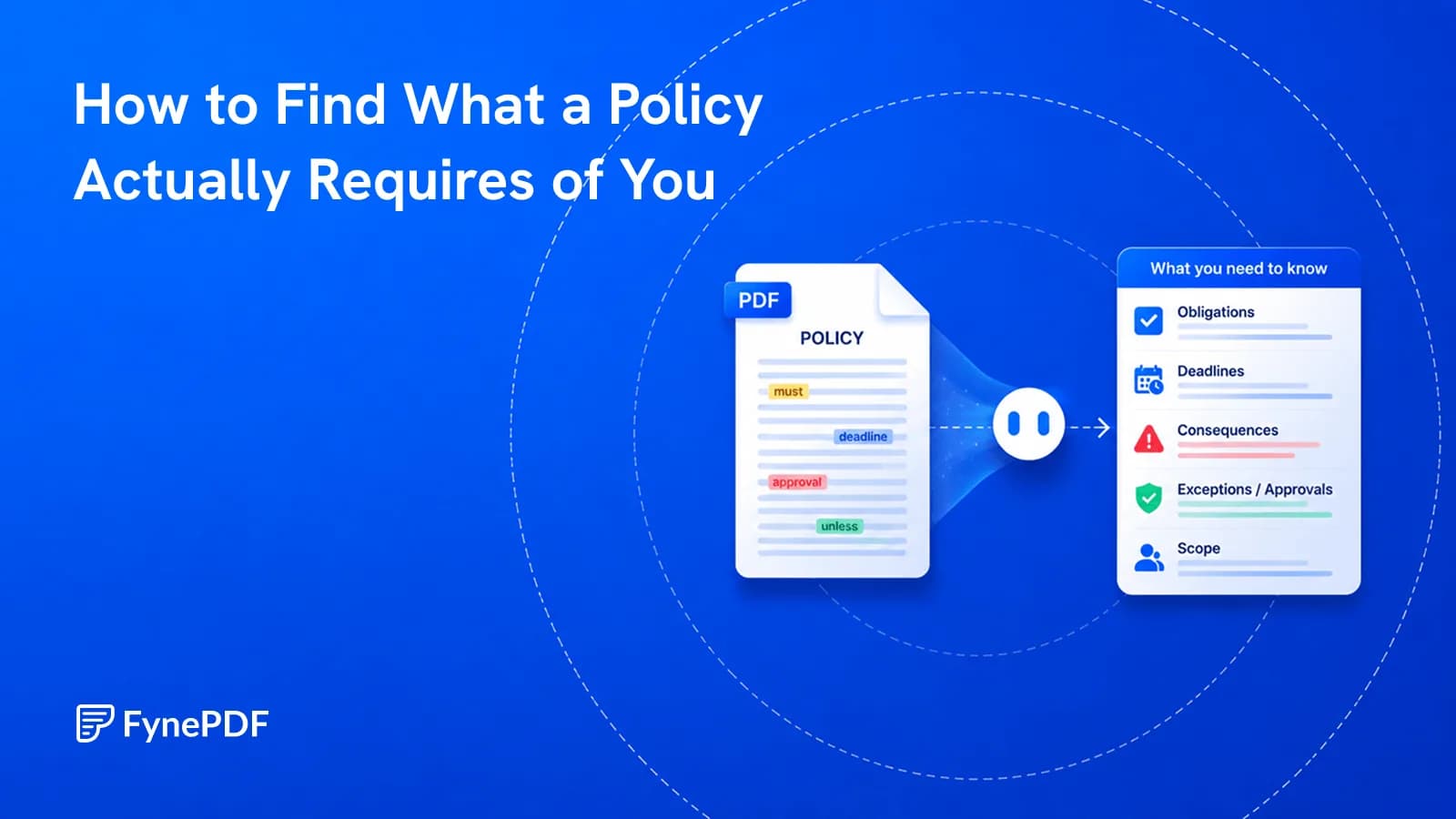
The agent scans dense chapters for obligations, guidelines and key rules.
Get the TL;DR
Get the TL;DR

Read the simplified summary, then ask the document about specific rules.

Ask Your Policy Document

Find what is required, allowed, or subject to exceptions.

Summarize a policy or handbook and ask about the rules relevant to your work. Find obligations, permissions, and exceptions with source references, then check the wording before sharing an answer with your team.

Find Policy Duties

Separate requirements from recommendations.

Create Policy FAQs

Turn policy sections into clear answers.

Ask About a Rule

Find relevant wording without exact keywords.

file-icon
Corporate_IT_Security_Policy_v4.pdfLast Updated: Today
What is the policy on using personal devices for work emails?
AIBased on Section 8.3 (BYOD Policy), using personal devices for company email is permitted, but requires specific security measures:
The RuleEmployees may access corporate email on personal mobile devices provided they install the company’s approved Mobile Device Management (MDM) profile.
TL;DR SummaryYes, you can use your personal phone, but you MUST let the IT department install security software on it first.
p.4Copy

Find the rule behind the answer.

Ask about requirements, permissions, and exceptions in the policy you upload.

Policy Sections

Find the section behind a policy answer, including nested rules and appendices. Check the source before quoting a requirement to your team.

Rules and Exceptions

Ask which exceptions, conditions, or limits apply to a policy rule. Review the wording that changes when a requirement must be followed.

Cited Policy Answers

Get policy explanations with page references you can check. Use the source wording to discuss requirements and clarify a rule with colleagues.

Explain, Summarize, Ask

Select text in your PDF to explain a term, summarize a passage, or ask a question. Explore the detail you need without retyping it into chat.

Highlighted Sources

Click a page citation to open your PDF at the source. When a text match is found, the passage is highlighted so you can check the AI answer.

Export Tables as CSV

Download tables from AI answers as CSV files. Keep the rows and columns ready for Excel, Google Sheets, or your next document analysis.

Find the Rules You Need

Turn a policy document into a focused summary with answers tied to its pages.

HR Teams

Summarize handbook rules about leave, travel, or employee responsibilities. Create a working FAQ and check each answer against the cited policy.

Compliance Teams

Extract responsibilities, deadlines, and exceptions from an uploaded policy. Build a review checklist and check it against the source document.

Employees

Ask about travel allowances, leave rules, and approval steps in your policy. Follow page citations to check the terms relevant to your situation.

Document Privacy

How your files are handled during and after your session.

No AI Training

Your documents are used for your session and are never used to train AI models.

Encrypted Transfers

TLS protects document transfers between your browser and FynePDF.

Auto-Deletion

Your file is deleted within 24 hours of upload, unless you save it to your Library.

Privacy Policy

Read how we handle document data and how to contact us about access, export, or deletion.

Your policy is processed to prepare summaries and answer questions about its rules. FynePDF staff do not manually open or review your file contents.

AI features may send document content to the Google Gemini API to produce the output you request. Documents are not used to train AI models. Temporary files follow the deletion policy; saved documents follow the Library storage policy.
Read our full Security Policy.

Frequently Asked Questions

Can it handle complex government regulatory PDFs?

Yes, and the structure is the reason it works. Regulatory documents, OSHA standards, ISO frameworks, HIPAA rules, internal compliance manuals, are built on deep hierarchical numbering, and the agent tracks that structure rather than flattening it, so an answer tells you it came from Section 4.2.1 rather than just asserting the rule. That matters more here than in most documents: a compliance answer you can't trace to a clause isn't an answer you can act on or hand to anyone else.

Can I generate a summary to share with my team?

Three ways. Copy an individual answer or generated FAQ straight from the chat, or download the whole session as a .txt file to paste into a wiki or circulate, both work on the free plan. Saving a session to your Library so colleagues' questions can be answered from the same thread later is included with Professional and Premium.

How do I find one specific rule in a 200-page document?

Ask for it. Upload the document once and put the question in plain language, "what's the per diem for domestic travel?", "how much carry-over leave can I take?", "can I use a personal laptop?", and the agent returns the rule, any exceptions attached to it, and the section it came from. That's the difference from searching the PDF: search finds a word if you guess the word the document uses, while this finds the rule even when the handbook calls it something else entirely.

Can I use Policy Summarizer for free?

Yes. Read a document overview without signing in, then try one AI answer by typing a question, choosing a suggestion, or running the analysis. Each new upload gets one answer, shared across tools and agents. A paid plan unlocks further interactions within its AI allowance.

How secure are my files and data?

File transfers use TLS encryption. AI features may send document content to the Google Gemini API to generate the output you request. Documents are not used to train AI models. Temporary AI files are deleted within 24 hours of upload; files saved to your Library follow the Library storage policy. Read the Privacy Policy for details.

Does this work for insurance policies as well?

It reads them, but it isn't built for them. This agent is designed for organisational documents, employee handbooks, IT and security policies, compliance manuals, regulatory standards, where the job is finding a rule and its exceptions inside a deep structure. For an insurance policy, an Explanation of Benefits or a denial letter, Claims and Denial Checker is the right tool: it handles coverage terms, denial codes and patient-responsibility amounts, which this one doesn't.

Will it tell me which section a rule comes from?

Yes, on every answer. The agent tracks the document's hierarchy, Section 4.2.1, Appendix B, Clause 7(a), and reports where each answer came from, so you can quote the rule and point someone at the exact clause. That's usually the difference between an answer you can use and one you can't: nobody accepts "the policy says you can't" without a reference, and checking the wording yourself takes seconds once you know where to look.

Can it turn a handbook into an FAQ for staff?

Yes, and it's one of the better uses of it. Ask for the questions employees actually ask, leave, expenses, remote work, equipment, notice periods, and the agent produces plain-language answers drawn from the handbook, each with its source section. That gives you a staff-facing FAQ that's accurate because it's grounded in the document, and auditable because every answer points back to the clause it came from. Copy the output into your intranet or wiki, and regenerate it when the handbook is revised.

What are the exceptions to a rule, and will it find them?

That's what it's best at. Policies are built out of exceptions "unless," "except where," "subject to prior approval," "at the manager's discretion", and they're the part people miss, because the general rule reads as complete on its own. Ask about any rule and the agent returns the conditions attached to it alongside the rule itself. It's worth asking explicitly ("are there any exceptions to this?") on anything you're about to rely on, since a conditional buried three subsections away is the usual way a policy gets broken by accident.