fynepdf logo
Plagiarism & AI Detector

Plagiarism & AI Detector

Check a draft for copied passages and AI-generated writing before you submit it.

Plagiarism & AI Writing Check

Supports PDF, TXT and more

Youβ€œIs this essay original?”
AI AvatarFyne Botβ€œNo. 68% matches AI generation patterns”

or drop your file here

File upload

Check Your Draft in 3 Steps

Review originality risks before you submit.
Secure Submission
Secure Submission

Drop the essay, article, or research paper into our isolated scanner.
Pattern Review
Pattern Review

The agent reads for uncited quotes, tone shifts and formulaic phrasing.
Get the Report
Get the Report

Get each concern rated Low, Moderate or Elevated, with the page it sits on.

Review Writing Patterns

Explore attribution concerns and AI-style phrasing.

Review your PDF for attribution gaps, tone shifts, and phrasing that may read as AI-generated. Each concern comes with context to guide your review; it does not prove plagiarism or establish who wrote the text.

Review AI-Style Phrasing

Find generic wording and repetitive patterns.

Check Attribution

Review quotes and passages without sources.

Find Tone Shifts

Spot changes in voice across the draft.
file-icon
History_Final_Draft.docxScan Complete
What originality risks should I review in this essay?
AII scanned the document and found several originality concerns. Here is the breakdown:
Overall Concern

Elevated


Flagged AI Text (Paragraph 3)β€œIn conclusion, the multifaceted nature of the industrial revolution played a pivotal role in shaping modern societal infrastructures...”
p.4Copy

Review writing concerns with context.

Examine attribution gaps and AI-style phrasing, with reasons rather than a verdict.

Passage-Level Review

Find passages with shifts in tone, generic phrasing, or unclear attribution. Review each concern in context within your uploaded document.

Reasons, Not Scores

See why a passage raises a writing concern. Use the explanation to guide a closer review without treating it as proof of who wrote the text.

Document-Based Checks

Review attribution and writing patterns within your PDF. This check uses your document and does not search a web-wide similarity database.

Explain, Summarize, Ask

Select text in your PDF to explain a term, summarize a passage, or ask a question. Explore the detail you need without retyping it into chat.

Highlighted Sources

Click a page citation to open your PDF at the source. When a text match is found, the passage is highlighted so you can check the AI answer.

Export Tables as CSV

Download tables from AI answers as CSV files. Keep the rows and columns ready for Excel, Google Sheets, or your next document analysis.

Review Writing with Context

Explore citation gaps and writing patterns as starting points for a closer review.

Educators

Review passages that may need source checks or a discussion with the writer. Treat AI-writing signals as prompts for review, rather than proof.

Publishers & Editors

Inspect repetitive phrasing and passages that need attribution in a draft. Ask for explanations and verify sources before making an editorial call.

Students & Writers

Review attribution and wording before sharing your draft. Explore flagged passages and improve citations without treating AI signals as a verdict.

Document Privacy

How your files are handled during and after your session.

No AI Training

Your documents are used for your session and are never used to train AI models.

Encrypted Transfers

TLS protects document transfers between your browser and FynePDF.

Auto-Deletion

Your file is deleted within 24 hours of upload, unless you save it to your Library.

Privacy Policy

Read how we handle document data and how to contact us about access, export, or deletion.

Your draft is processed to review attribution and writing patterns within your session. FynePDF staff do not manually open or review your file contents.

AI features may send document content to the Google Gemini API to produce the output you request. Documents are not used to train AI models. Temporary files follow the deletion policy; saved documents follow the Library storage policy.
Read our full Security Policy.

Frequently Asked Questions

Can it detect the newest versions of ChatGPT and Claude?

Not reliably, and no tool can, including the ones that say otherwise. What this does is different: it reads your draft for the patterns that make writing look generated, uniform sentence rhythm, generic transitions, an absence of specific detail, a voice that doesn't vary, and tells you which passages carry that risk. That's useful for deciding what to rewrite before you submit. It is not evidence of authorship, and it should never be used as evidence about someone else's.

What is a false positive in AI detection?

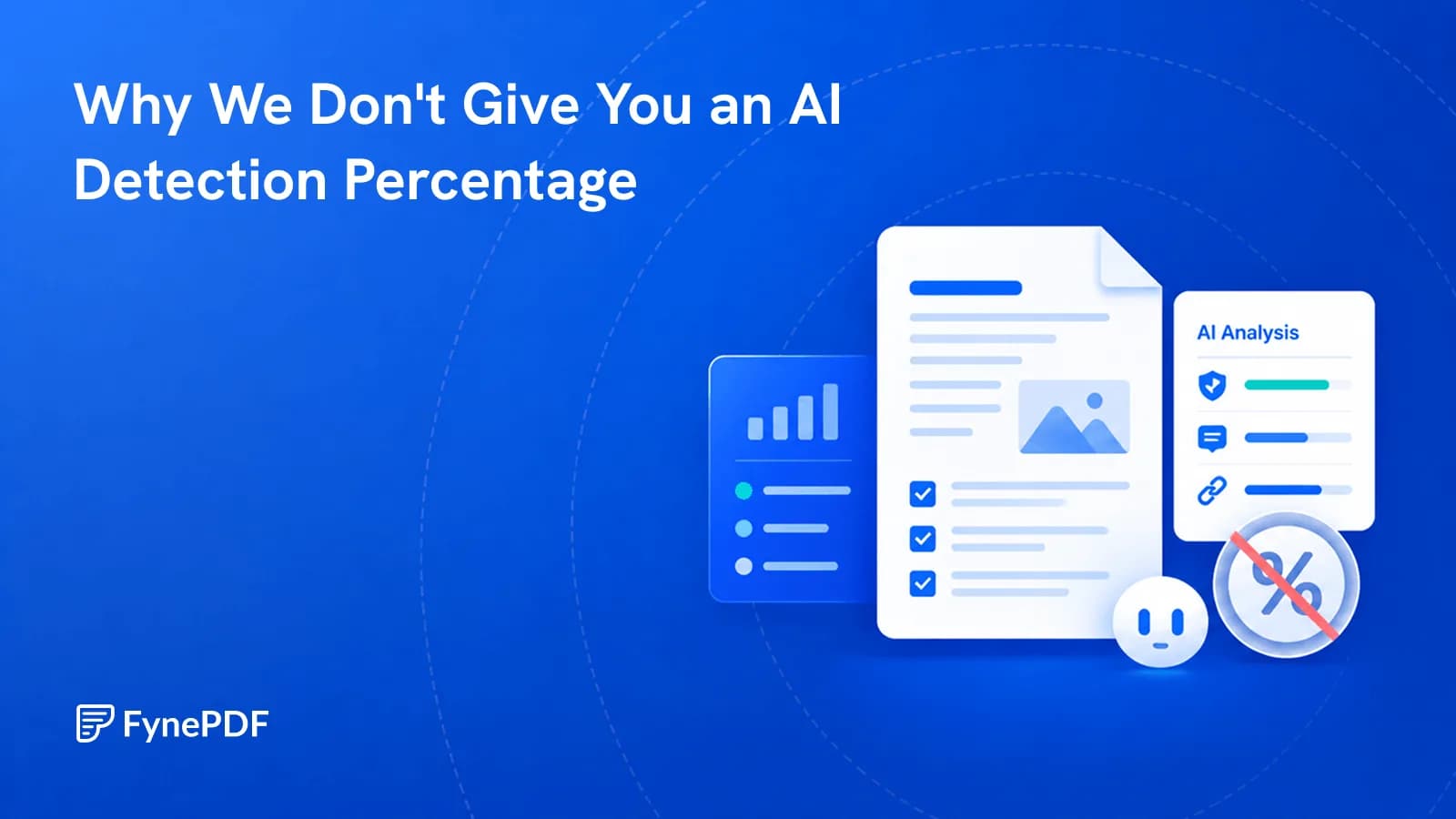
It's human writing wrongly flagged as machine-written, and it happens a lot, particularly to non-native English speakers, to people writing in a formal register, and to anyone whose subject demands consistent, unadorned prose. It's the main reason detection scores shouldn't be treated as proof of anything. This tool doesn't produce a score or a verdict for exactly that reason: it identifies passages that carry risk and explains why, so you can decide whether to change them. If your work has been flagged elsewhere, having concrete reasons is more useful than a percentage you can't argue with.

Will uploading my essay flag it in other checkers like Turnitin?

File transfers use TLS encryption. AI features may send document content to the Google Gemini API to generate the output you request. Documents are not used to train AI models. Temporary AI files are deleted within 24 hours of upload; files saved to your Library follow the Library storage policy. Read the Privacy Policy for details.

Can I use this for free?

Yes. Read a document overview without signing in, then try one AI answer by typing a question, choosing a suggestion, or running the analysis. Each new upload gets one answer, shared across tools and agents. A paid plan unlocks further interactions within its AI allowance.

How secure are my files and data?

File transfers use TLS encryption. AI features may send document content to the Google Gemini API to generate the output you request. Documents are not used to train AI models. Temporary AI files are deleted within 24 hours of upload; files saved to your Library follow the Library storage policy. Read the Privacy Policy for details.

Does this check my work against the internet?

No, and that's worth being clear about before you upload. There's no web search, no database of published work, and no similarity index, so it can't tell you a passage matches a specific source, and it won't give you a percentage. What it does is read your draft on its own terms: quoted or closely-tracked material with no citation attached, sections whose voice breaks from the rest, phrasing that reads as generated. Those are the things that get work questioned, and they're all visible from the inside. If you need a genuine source-matching report, a dedicated similarity service is what you want; this is for fixing your own draft before it goes anywhere.

Can I use this to check whether a student used AI?

Please don't rely on it for that. No tool can establish authorship, and this one is explicitly built not to draw that conclusion, it flags stylistic risk in a draft, which is not evidence about who wrote it. AI-detection false positives fall hardest on non-native English speakers and on formal academic registers, and an accusation built on a flag is a serious thing to get wrong. Where it is genuinely useful in teaching is with the student rather than about them: showing someone which passages read as generated, and why, is a conversation about writing rather than a verdict.

What should I do about a passage it flags?

Read it and ask what's actually going on. If it's flagged for attribution, you probably quoted or paraphrased something and lost the citation, find the source and add it. If it's flagged for tone, that section likely came from a different drafting session, or from somewhere else, and rewriting it in your own voice fixes it. If it's flagged as formulaic, the passage may just be doing routine work, a methods section reads uniformly because it should, and no change is needed. A flag is a prompt to look, not a verdict.