fynepdf logo
Medical Report Analyzer

Medical Report Analyzer

Understand your lab results, diagnoses and medications in plain, jargon-free English.

Plain-English Lab Results

Supports PDF, TXT and more

You“What does ‘Elevated ALT’ mean?”
AI AvatarFyne Bot“ALT is a liver enzyme. Yours...”

or drop your file here

File upload

Understand Your Report in 3 Simple Steps

Read explanations of the report and prepare questions for your clinician.
Private Upload
Private Upload

Drop your report. It's encrypted in processing and never used to train AI.
AI Jargon Check
AI Jargon Check

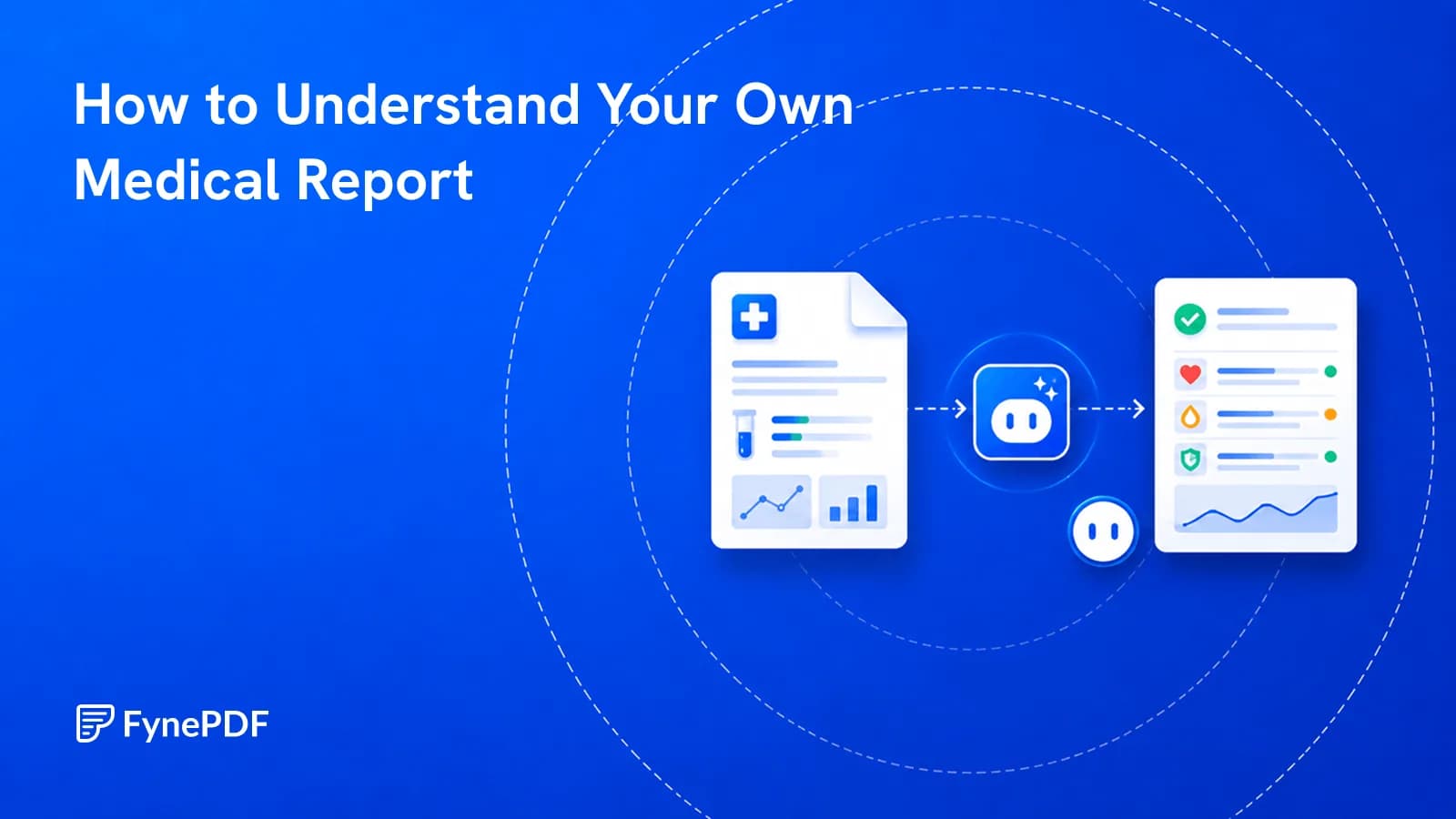
The agent explains acronyms and lab results against their reference ranges.
Understand
Understand

Ask follow-up questions and prepare a list of topics for your doctor.

Read Your Medical Report

Understand the terms and prepare useful questions.

Get plain-language explanations of a medical report's terms, units, and reference ranges. Ask about a selected passage and prepare questions for your clinician while keeping the original report in view.

Explain Lab Values

Read results with their units and ranges.

Understand Clinical Notes

Clarify medical terms and abbreviations.

Prepare for Your Visit

List questions to discuss with your doctor.

file-icon
Blood_Panel_Results.pdfGenerated from Patient Portal
Is my Hemoglobin A1C level normal?
AIYour result sits inside the reference range printed on the report
Your ResultHemoglobin A1C: 5.4%
What this meansA1C measures your average blood sugar over the last 3 months. A normal range is below 5.7%. Yours is 5.4%, meaning you are not currently in the pre-diabetic or diabetic range.
Disclaimer: Educational purposes only
p.4Copy

Understand the words in your medical report.

Explore lab values, clinical terms, and questions to bring to your next appointment.

Medical Terms Explained

Understand the medical words and abbreviations in your report. Use the explanations to prepare questions for a clinician, not a diagnosis.

Read Values in Context

Ask about a result alongside the units and reference range printed in your PDF. Review the report's wording before discussing it with a doctor.

Prepare Your Questions

Turn unfamiliar results or clinical notes into questions for your appointment. Keep the original report handy to discuss with your clinician.

Explain, Summarize, Ask

Select text in your PDF to explain a term, summarize a passage, or ask a question. Explore the detail you need without retyping it into chat.

Highlighted Sources

Click a page citation to open your PDF at the source. When a text match is found, the passage is highlighted so you can check the AI answer.

Export Tables as CSV

Download tables from AI answers as CSV files. Keep the rows and columns ready for Excel, Google Sheets, or your next document analysis.

Understand Your Report

Explore medical terms and prepare questions for a conversation with your clinician.

Patients

Ask about medical terms and values listed in your report. Follow page citations to check the details and prepare questions for your clinician.

Family Caregivers

Read a discharge summary in plain language and clarify unfamiliar terms. Gather questions about the document for the person's care team.

Patient Support Teams

Explain terminology in an uploaded report using plain language. Check the original wording and prepare discussion points for the clinical team.

Document Privacy

How your files are handled during and after your session.

No AI Training

Your documents are used for your session and are never used to train AI models.

Encrypted Transfers

TLS protects document transfers between your browser and FynePDF.

Auto-Deletion

Your file is deleted within 24 hours of upload, unless you save it to your Library.

Privacy Policy

Read how we handle document data and how to contact us about access, export, or deletion.

Your report is processed to explain the medical terms and listed values you ask about. FynePDF staff do not manually open or review your file contents.

AI features may send document content to the Google Gemini API to produce the output you request. Documents are not used to train AI models. Temporary files follow the deletion policy; saved documents follow the Library storage policy.
Read our full Security Policy.

Frequently Asked Questions

Is this tool giving me a medical diagnosis?

No. It's a translation tool: it tells you what the words and numbers on your report mean, and what the reference ranges printed alongside them are for. It does not diagnose, does not tell you whether a result is a problem for you specifically, and does not recommend treatment, because a number that's unremarkable for one person can matter a great deal for another, and only someone who knows your history can tell the difference. Use it to walk into your appointment, understand the document, and take every question it raises to your doctor.

Will my health records be saved or stored?

File transfers use TLS encryption. AI features may send document content to the Google Gemini API to generate the output you request. Documents are not used to train AI models. Temporary AI files are deleted within 24 hours of upload; files saved to your Library follow the Library storage policy. Read the Privacy Policy for details.

Can it read PDFs from my patient portal?

Yes. Reports exported or downloaded from portals like MyChart, and PDFs from most hospital and lab systems, are read normally and OCR runs automatically, so a scan or a photograph of a printed result works too. Tables of values with their reference ranges, clinical notes and discharge summaries all read fine. If your portal only shows results on screen with no download, a screenshot saved as an image or PDF works as well.

Can I use the Medical Report Analyzer for free?

Yes. Read a document overview without signing in, then try one AI answer by typing a question, choosing a suggestion, or running the analysis. Each new upload gets one answer, shared across tools and agents. A paid plan unlocks further interactions within its AI allowance.

How secure are my files and data?

File transfers use TLS encryption. AI features may send document content to the Google Gemini API to generate the output you request. Documents are not used to train AI models. Temporary AI files are deleted within 24 hours of upload; files saved to your Library follow the Library storage policy. Read the Privacy Policy for details.

What do my blood test results actually mean?

Every lab report prints a reference range next to each value, the band most healthy people fall into for that lab's equipment and population. A result outside it isn't automatically a problem: ranges vary between labs, some markers shift with age, sex, medication, hydration, time of day and whether you fasted, and a single reading out of range is common and often meaningless on its own. What matters more is the pattern, several related markers moving together, or one value drifting across repeated tests. Upload the report and ask what each value measures and what its range is for; take the ones that stand out to your doctor rather than to a search engine.

Why is one of my results flagged high or low?

A flag just means the value sits outside that lab's reference range, it's a formatting convention, not an assessment. Common innocent causes include not having fasted, dehydration, recent exercise, an ordinary infection, medication or supplements, and normal variation between draws. Some markers are also flagged routinely in people for whom they're expected, such as during pregnancy or with a known chronic condition. What the flag reliably tells you is to ask about this one. The agent explains what the marker measures and what commonly moves it, so the conversation with your doctor starts further along.

Should I look my symptoms up online while I wait?

It's what everyone does and it's the worst available option, because search ranks by what's dramatic rather than what's likely, one term out of context returns the rarest and most frightening explanation first. A report read as a whole usually looks very different from any single line in it. If you're waiting on an appointment, understanding what the document actually says is the useful version of the same impulse, and writing down the two or three questions it raises turns the wait into preparation. If something on the report worries you enough that waiting feels unsafe, that's a reason to call your doctor's office now rather than to keep reading.

Can it explain a discharge summary or a specialist letter?

Yes, and those are often harder to read than lab results because they're written by one clinician for another. The agent works through the abbreviations, the medication names and doses, the follow-up instructions and what the stated findings mean, including the parts that assume knowledge you weren't given. It's particularly useful if you're caring for someone else and weren't in the room. As always, anything about what to do next belongs with the treating clinician; this tells you what the letter says, not what to do about it.