fynepdf logo
Accessibility (WCAG) Checker

Accessibility (WCAG) Checker

Check PDFs for WCAG 2.2 and Section 508 issues, explained in plain English.

WCAG 2.2 & Section 508

Supports PDF, TXT and more

You“Does this meet contrast rules?”
AI AvatarFyne Bot“No, text on pg. 3 fails to...”

or drop your file here

File upload

Review Accessibility in 3 Steps

Explore possible document barriers and prepare checks for a formal accessibility audit.
Upload
Upload

Drop PDF brochures, financial reports or wireframes into the workspace.
AI Scanning
AI Scanning

The agent reads your heading order, image labelling and reading sequence.
Review & Remediate
Review & Remediate

Get a list of exactly which elements failed and how to fix each one.

Review PDF Accessibility

Find areas to check before formal accessibility testing.

Use AI to guide a PDF accessibility review. Ask about headings, reading order, or figure descriptions, and turn possible barriers into a practical checklist for formal testing and remediation.

Review Image Descriptions

Find figures to check for useful alt text.

Review Contrast Risks

Identify areas for measured contrast checks.

Check Heading Order

Review heading levels and reading sequence.

file-icon
City_Budget_Report_2026.pdfStatus: Pending Audit
Are the heading tags in this document logical?
AINo. On page 4, "Revenue Breakdown" is styled as a third-level heading but follows a top-level one with nothing in between a skipped level, which breaks WCAG 1.3.1 (Info and Relationships). Screen readers use heading order to build a navigable outline.
Failed CompliancePage 4 skips directly from an <H1> tag to an <H3> tag. Screen readers rely on nested logic to map the page.
Remediation ActionPromote “Revenue Breakdown” to a second-level heading, and make sure it's tagged as one when you export. .
p.4Copy

Plan a clearer PDF accessibility review.

Use AI findings to guide checks of headings, reading order, and document descriptions.

Accessibility Checks

Review possible WCAG or Section 508 issues in your PDF. Use the findings to plan formal testing and identify areas that need closer checks.

Practical Findings

Understand possible accessibility barriers in plain language. Ask why a heading, reading sequence, or missing description needs attention.

Share Review Notes

Turn your accessibility review into a practical fix list. Save the conversation and share the suggested checks with your design or dev team.

Explain, Summarize, Ask

Select text in your PDF to explain a term, summarize a passage, or ask a question. Explore the detail you need without retyping it into chat.

Highlighted Sources

Click a page citation to open your PDF at the source. When a text match is found, the passage is highlighted so you can check the AI answer.

Export Tables as CSV

Download tables from AI answers as CSV files. Keep the rows and columns ready for Excel, Google Sheets, or your next document analysis.

Prepare for Accessibility Review

Explore possible barriers and organize checks before a formal document audit.

Document Designers

Review possible reading-order, heading, and text-description issues in a PDF. Use the findings to plan checks with accessibility testing tools.

Accessibility Teams

Organize potential document barriers into a review checklist. Ask what to inspect and confirm the findings through formal accessibility testing.

Content Creators

Review how a PDF explains images, links, and section headings. Gather practical revisions to discuss with your design and accessibility teams.

Document Privacy

How your files are handled during and after your session.

No AI Training

Your documents are used for your session and are never used to train AI models.

Encrypted Transfers

TLS protects document transfers between your browser and FynePDF.

Auto-Deletion

Your file is deleted within 24 hours of upload, unless you save it to your Library.

Privacy Policy

Read how we handle document data and how to contact us about access, export, or deletion.

Your PDF is processed to provide feedback for an accessibility review. FynePDF staff do not manually open or review your file contents.

AI features may send document content to the Google Gemini API to produce the output you request. Documents are not used to train AI models. Temporary files follow the deletion policy; saved documents follow the Library storage policy.
Read our full Security Policy.

Frequently Asked Questions

Which WCAG levels does it check against?

It works to WCAG 2.1 and 2.2, focused on AA, the level referenced by most legal frameworks including Section 508 and the European Accessibility Act, and will note AAA improvements where they're straightforward. What it checks is the document-level side of those criteria: heading order and reading sequence, whether figures carry descriptions, link text, language clarity, table structure and scanned-page problems. Criteria that depend on how a file is tagged internally, or on measured colour values, need a validator, see the next answer.

Can it check scanned or flat PDFs?

Yes, and this is one of the clearest results it gives. OCR runs automatically so the text is readable, but a purely scanned PDF is flagged as inherently inaccessible, it's a picture of a page, with none of the internal structure a screen reader needs to navigate it. No amount of remediation on the visual layer fixes that; the document has to be rebuilt from a tagged source or run through OCR PDF and then properly tagged. It's worth checking this first, because it changes the whole scope of the job.

Does this replace a formal accessibility audit?

No, and it's important to be precise about why. This is a pre-check: it reads your document's content and structure as they appear and tells you, in plain English, what a screen reader user would struggle with. What it can't do is read a PDF's internal tag tree or measure colour values, so it won't confirm PDF/UA tagging or calculate a contrast ratio to the decimal. For those, a dedicated validator like PAC or Adobe's built-in checker is the right next step, and for legal certification, testing with actual screen reader users is still the standard. Use this to find out what you're dealing with and how much work it is, before you get to any of that.

Can I use the Accessibility Checker for free?

Yes. Read a document overview without signing in, then try one AI answer by typing a question, choosing a suggestion, or running the analysis. Each new upload gets one answer, shared across tools and agents. A paid plan unlocks further interactions within its AI allowance.

How secure are my files and data?

File transfers use TLS encryption. AI features may send document content to the Google Gemini API to generate the output you request. Documents are not used to train AI models. Temporary AI files are deleted within 24 hours of upload; files saved to your Library follow the Library storage policy. Read the Privacy Policy for details.

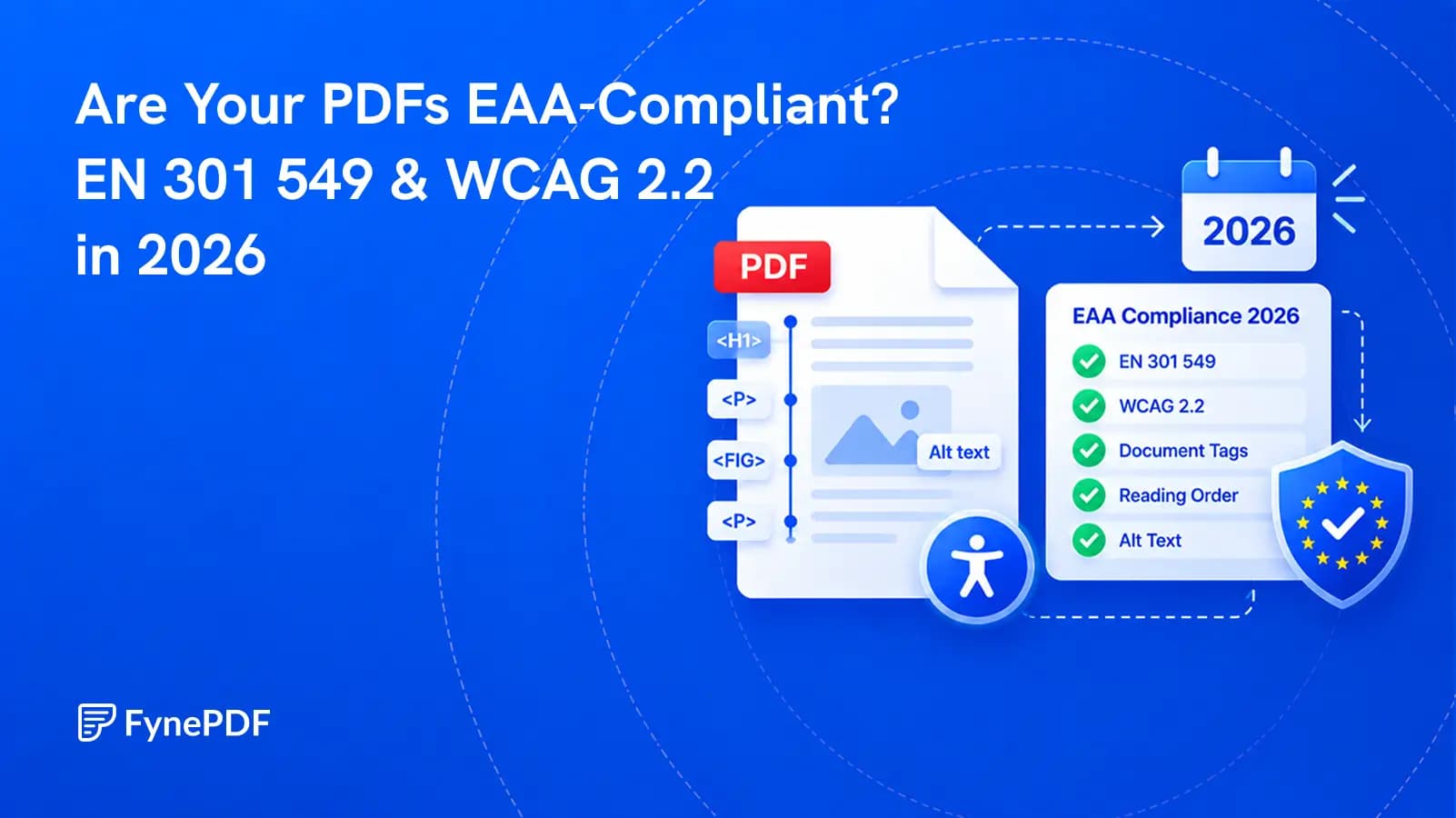
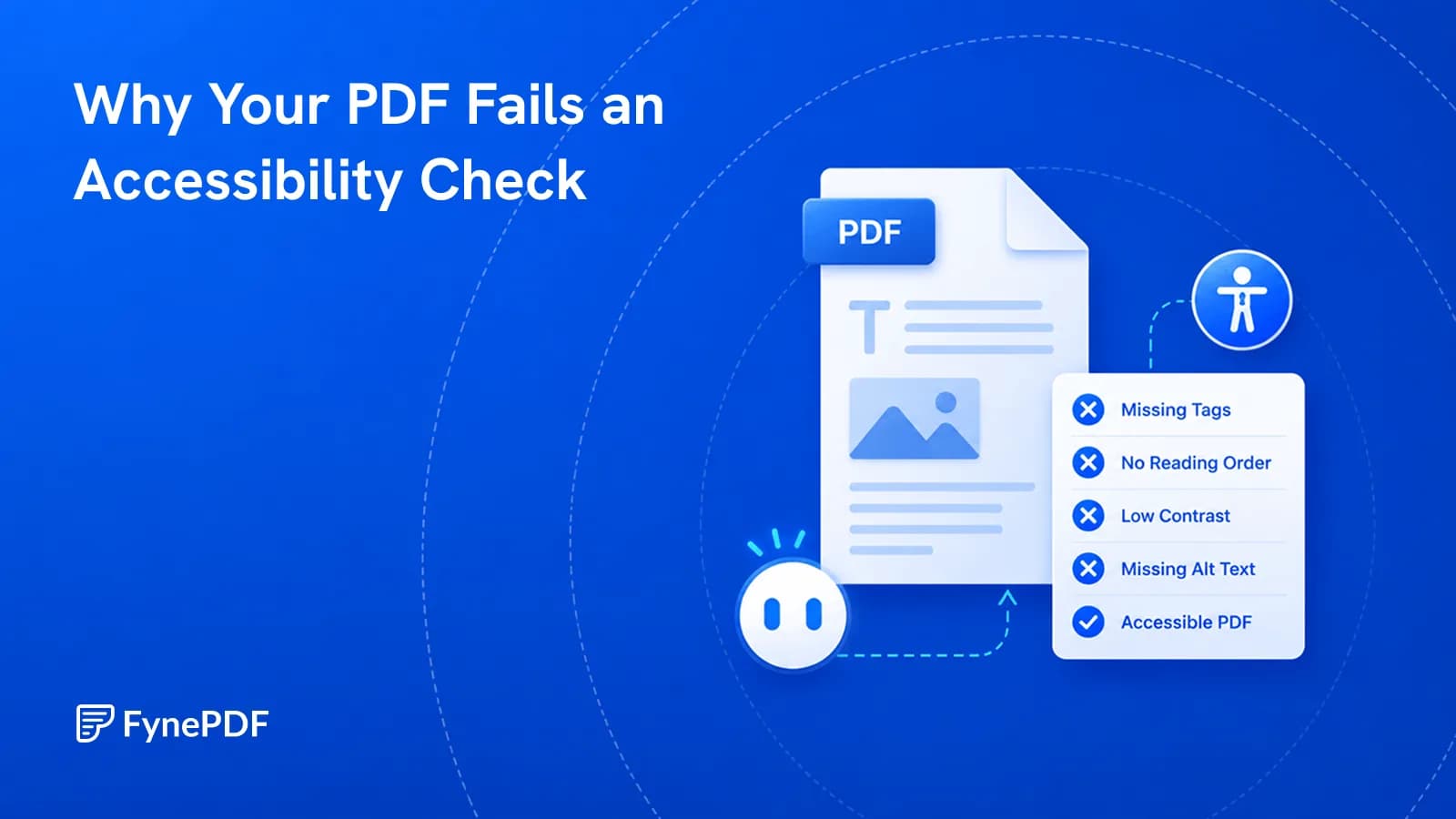
Why does my PDF fail an accessibility check?

Almost always one of five things. It's a scan, so there's no real text at all. It has no heading structure, so a screen reader gets one undifferentiated block instead of a navigable outline. Its images have no descriptions, so charts and diagrams are silent. Its reading order doesn't match the visual layout, which happens constantly with multi-column designs and text boxes, the screen reader reads the sidebar in the middle of a sentence. Or it was exported from a design tool that produced no tags at all, which is the usual reason a document that looks immaculate fails completely. Upload it and the agent tells you which of these you've got.

How do I make a PDF accessible?

Fix it in the source, not the PDF. Structure the original document with real heading styles rather than manually enlarged bold text, add alternative text to every image, set the document language, use real table headers, and give links descriptive text instead of "click here", then export with tagging enabled (Word, InDesign and Google Docs all have this, and it's usually off by default). Remediating an already-exported PDF is possible in Acrobat but it's slow, and for a document you'll update annually it's work you'll repeat every year. Run the file through here first to see how far off it is, since that decides whether you're fixing or rebuilding.

Does a document that looks fine pass?

Appearance alone does not establish PDF accessibility. A document can look clear while missing heading tags, image descriptions, or a useful reading order. Review those structural details as well as the visual layout. AI feedback can help plan the review; confirm the results with accessibility testing tools.

Which laws actually require this?

It depends where you are and who you are. In the US, Section 508 covers federal agencies and their contractors, and the ADA has been applied to public-facing digital content through case law. In the EU, the European Accessibility Act extends obligations to many private-sector services. The UK, Canada and Australia have their own equivalents. Most of them reference WCAG 2.1 or 2.2 Level AA as the technical standard, which is why that's the level to work to. What counts as compliance in your specific situation is a legal question, and this tool doesn't answer it, it tells you what's wrong with the document.