


Compare More Than 10 PDFs at Once: Assignments, Resumes & More
Review a whole document set against the same questions, then verify every important finding at its source.

4 October 2026 · By Biraj Paudel, Founder of FynePDF
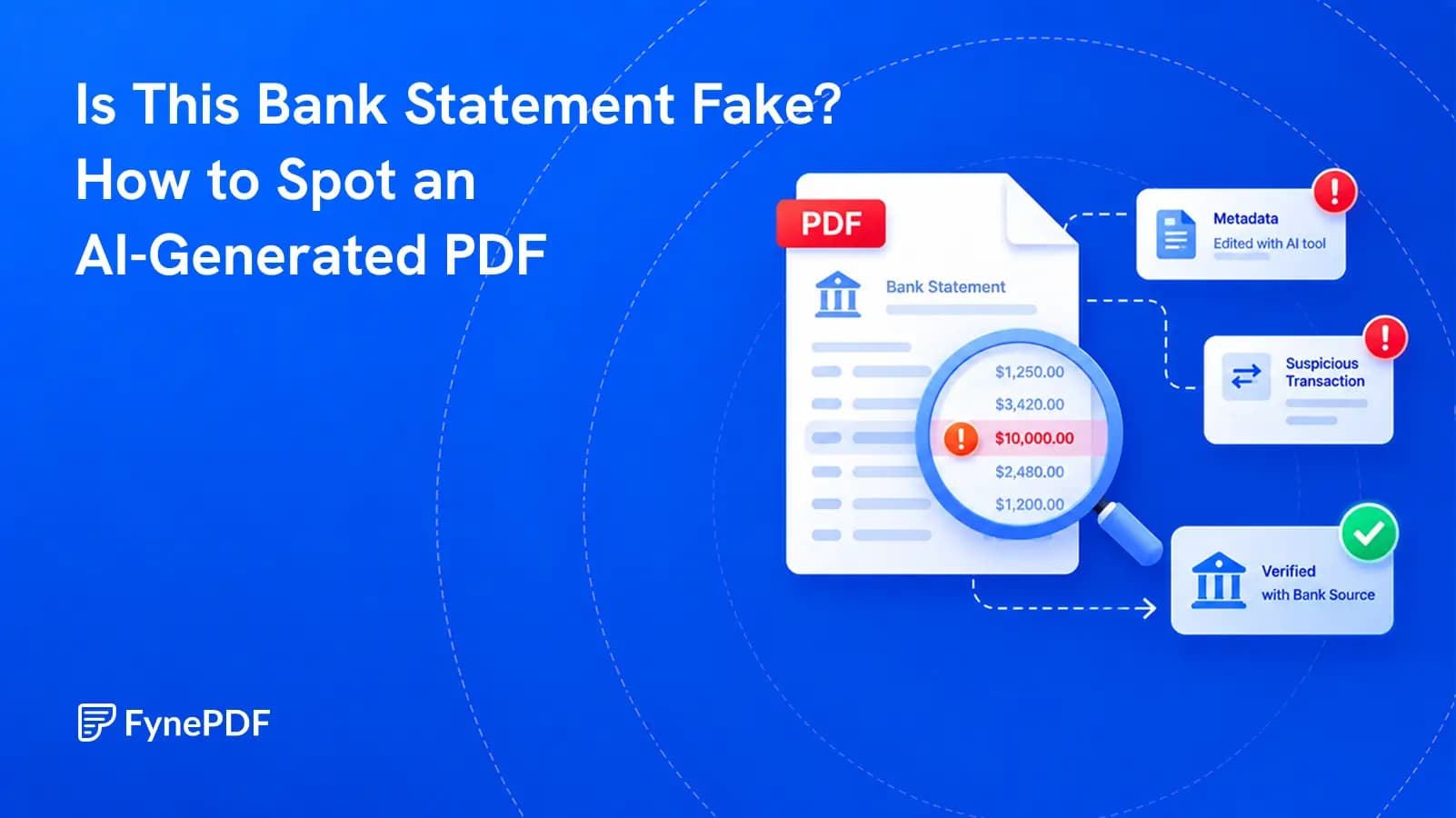
AI can copy a bank's design in seconds. The safest check is not how the PDF looks, but whether its claims match a trusted source.
You cannot reliably prove that a bank statement is genuine by looking at the PDF alone. AI can reproduce logos, tables, fonts, and transaction descriptions. Traditional editing software can alter a genuine statement just as easily.
The safest approach is to verify the financial claim, not guess how the document was made. Check the statement's internal numbers, compare it with other records, and then confirm the data through a trusted bank channel or a regulated account-information service when the stakes justify it.
The word "fake" covers several different problems:
These cases do not leave the same clues. A perfect-looking statement can contain one changed number. An odd-looking statement may be genuine because it was scanned, translated, downloaded from an old portal, or produced by a small bank with an unfamiliar design.
That is why appearance should start an investigation, not end it.
Yes, mainly because it lowers the time and skill needed to create convincing material. It does not create a dependable new test for finding it.
In 2024, the U.S. Financial Crimes Enforcement Network reported increased suspicious activity involving generative AI and fraudulent identity documents used against financial institutions. Its deepfake fraud alert is broader than bank statements, but the lesson applies here: a familiar design and clean presentation are weak evidence when synthetic documents are easy to make.
The question "Was AI used?" can also distract from the question that matters: "Is the account information true?" A person can alter one balance without AI. An AI-generated template could, in theory, reproduce accurate figures. The method does not decide the truth of the data.
No single item below proves fraud. Several unrelated problems in the same document justify a stronger source check.
Start with arithmetic. For a simple account statement, the opening balance plus credits minus debits should reach the closing balance, using the bank's own sign convention.
Then check the running balance after each transaction. A changed deposit may look natural but cause every later balance to be wrong. Also check any totals printed in summaries, such as deposits, withdrawals, fees, and interest.
Allow for the statement's rules. Pending payments, reversed transactions, holds, foreign-exchange adjustments, and separate credit-card conventions can make a quick calculation misleading. Read the labels before deciding that a difference is suspicious.
A statement that fails its own arithmetic has a serious problem. A statement that passes may still be fake because a competent editor can preserve the math.
If you have several months, the previous closing balance should normally match the next opening balance. Account details, branch identifiers, and the way fees or interest are described should also remain reasonably consistent.
Look for gaps in the requested period, overlapping date ranges, duplicate pages, or page numbers that restart unexpectedly. These are stronger signals than a logo that appears slightly blurred.
Possible clues include a different font in one amount, uneven baselines, inconsistent decimal spacing, a box that covers part of a transaction, or one page with different margins and image quality.
There are innocent explanations. A bank may redesign its statements. A downloaded PDF may have been combined with a scanned page. Accessibility software, printing, compression, or conversion can alter how fonts and images are stored.
Compare the questionable file with another statement downloaded from the same bank and the same period if you are authorized to do so. Do not compare it with a random image found online. Banks issue different layouts by country, product, language, account type, and delivery channel.
A statement used as proof of income should not be judged by one large deposit. Check whether the payer, frequency, and timing match the employment or business claim. A statement used as proof of address should be current and show the relevant account holder and address, if the receiving organization's rules require those fields.
This is corroboration, not profiling. An unusual spending pattern is not evidence of fraud. Focus on contradictions tied to the purpose for which the statement was supplied.
PDF properties can show a creator application, creation date, modification date, fonts, security settings, and other metadata. A recent modification date or an unexpected editing program can justify another question.
It cannot settle the case. Adobe's own documentation explains that PDF metadata can be edited or replaced. Legitimate files are also modified when they are downloaded, combined, compressed, OCR-processed, or passed through document-management software.
Treat metadata as a lead, never as a verdict.
Use a hierarchy. The further the evidence is from the issuing bank, the less it can prove.
| Evidence | What it can tell you | Weight |
|---|---|---|
| Data obtained from the bank through an authorized, consent-based service | The account and transactions were returned by the bank channel | Strongest practical check |
| A fresh statement downloaded from the account portal while the account holder is present | The file came from the live account session | Strong, if the session and file handling are controlled |
| A trusted bank digital signature that validates | The signed content has not changed since signing and the certificate chain is trusted | Strong for file integrity |
| Matching statements, CSV exports, tax records, payslips, or accounting records | Separate records support the same financial claim | Useful corroboration |
| Correct balances and consistent formatting | The document is internally plausible | Screening evidence only |
| Metadata, visual oddities, or an AI detector score | Something may deserve review | Weak on its own |
The UK's Financial Conduct Authority describes open banking as a regulated way for people and businesses to share bank-account data with trusted services. Its consumer guidance says account-information providers need the user's explicit consent. Other countries use different systems and rules, but the principle is useful: source data with informed consent is stronger than an emailed PDF.
Never ask an applicant, tenant, employee, customer, or client to send their banking password. Use a bank's own sharing function or an appropriately authorized provider, and collect only what your process genuinely requires.
Keep the file exactly as received. Do not print and rescan it, export it through another application, or save over it. Those actions can remove useful metadata and make later comparison harder.
Record when and how it arrived. An original attachment is more useful than a screenshot pasted into a document, even though neither proves authenticity by itself.
Are you checking account ownership, available funds, income, rent affordability, business turnover, or a particular transaction? Each purpose needs different evidence.
Do not collect months of private spending data when a narrower confirmation would do. Follow the law, policy, and consent requirements that apply to your organization and location.
Confirm that the account holder, masked account number, statement period, currency, and issuing institution match the claim. Note missing pages and unexpected date gaps.
Use contact details obtained independently from the bank's official website or another trusted source. A phone number printed inside a suspicious document may belong to the person who made it.
Check the opening and closing balances, transaction count, total credits, total debits, fees, and running balances. If you extract transactions into a spreadsheet, compare the row count and totals with the PDF.
FynePDF's Bank Statement Analysis agent can help turn transaction rows into structured data. It is an analysis tool, not an authenticity certificate. A clean extraction or balanced total does not prove that the original statement came from a bank.
For detailed extraction guidance, see How to Turn Bank Statement PDFs Into Usable Data.
One month can be manufactured more easily than a consistent history across several independent records. Compare consecutive statements and, when relevant and lawful, check whether payroll documents, invoices, tax records, or accounting exports support the same claim.
Do not demand extra personal data merely because it is available. The aim is proportionate verification, not a search through someone's private life.
A visible picture of a signature or a padlock icon means little. A certificate-based digital signature is different. Adobe explains that validating one can check the signer's trusted certificate and whether the signed content changed afterward.
If the PDF contains a digital signature, use a PDF reader's signature panel to validate it and inspect the certificate chain. A valid signature from a trusted bank certificate is strong integrity evidence. An unknown or self-signed certificate needs separate confirmation.
The absence of a signature is not evidence of fraud. Many banks issue ordinary unsigned PDFs.
When the decision affects a loan, tenancy, employment check, large payment, regulated duty, or suspected crime, visual review is not enough. Use your organization's approved verification channel.
That may mean asking the account holder to provide a new portal download, using a regulated account-information service with consent, or contacting the bank through an independently obtained number where the bank is permitted to respond.
If you are a consumer checking a statement or message that claims to come from your own bank, contact the bank through its official app, website, card, or a number you already trust. Do not use a link or telephone number supplied in the suspicious message.
| Situation | Why it matters | What to do |
|---|---|---|
| Only screenshots are provided when an original PDF is available | Screenshots remove file history and are easy to alter | Request the original download through the approved process |
| The person refuses any source-level check but pressures you to decide quickly | Urgency and blocked verification increase fraud risk | Pause the decision and follow escalation policy |
| Opening, running, or closing balances conflict | The document fails its own accounting logic | Recalculate, then request source data if unresolved |
| Consecutive months have unexplained gaps or mismatched balances | Pages or periods may be missing or assembled | Request the complete period and compare again |
| Metadata shows editing software or a date after submission | The file may have been processed or changed | Ask for an explanation, but do not treat metadata as proof |
| A digital signature reports changes after signing | Signed content may no longer match the issuer's version | Inspect the signature details and obtain a fresh copy |
Not with enough certainty to make the decision for you.
An AI system may point out inconsistent fonts, impossible totals, repeated image artifacts, or language that differs from the rest of the document. Those are review leads. They do not establish who created the file, whether AI was involved, or whether the account data is true.
A percentage makes this worse. "92% AI-generated" looks precise but does not tell you which financial claim is false or how the score was validated for that bank's statements. The score should never replace source verification or become the sole basis for an adverse decision.
Use automation to organize evidence and find anomalies. Keep the final judgement with a trained person following a documented process.
Yes. Most digitally generated PDFs contain selectable text. Editable content is not proof that the file was altered. The relevant question is whether the received file matches information from the issuing bank.
No. Reconciliation catches careless changes and extraction mistakes. A fabricated statement can still contain perfect arithmetic.
It may be acceptable for a low-risk personal check, depending on the recipient's policy, but it is weak evidence for a consequential decision. Screenshots are easy to crop and edit and do not carry the structure or provenance of an original file.
Not when you already suspect the document. Find the bank's official contact details independently. Banks may be unable to disclose account information to a third party, so follow an approved, consent-based process.
No. FynePDF can extract transactions, help reconcile balances, and make anomalies easier to review. Only source-level evidence can provide strong confirmation that the data came from the bank.
Contact your bank promptly through a trusted channel. In the United States, the Consumer Financial Protection Bureau advises consumers to report unauthorized withdrawals immediately and explains that some legal notice periods can affect liability.
A forged bank statement no longer needs obvious spelling errors or a crooked logo. That makes old visual checklists less useful, but it does not make verification impossible.
Preserve the original. Reconcile the numbers. Compare periods and supporting records. Treat metadata and AI scores as clues. When the decision matters, move to data obtained from the bank or another approved source with the account holder's informed consent.
The strongest conclusion is not "this PDF looks real." It is "the facts in this PDF match evidence that did not come from the PDF."
Try it yourself
Review a whole document set against the same questions, then verify every important finding at its source.
The standard changed in September 2026, but the legal reference has not changed yet. Here is what that means for PDF teams.
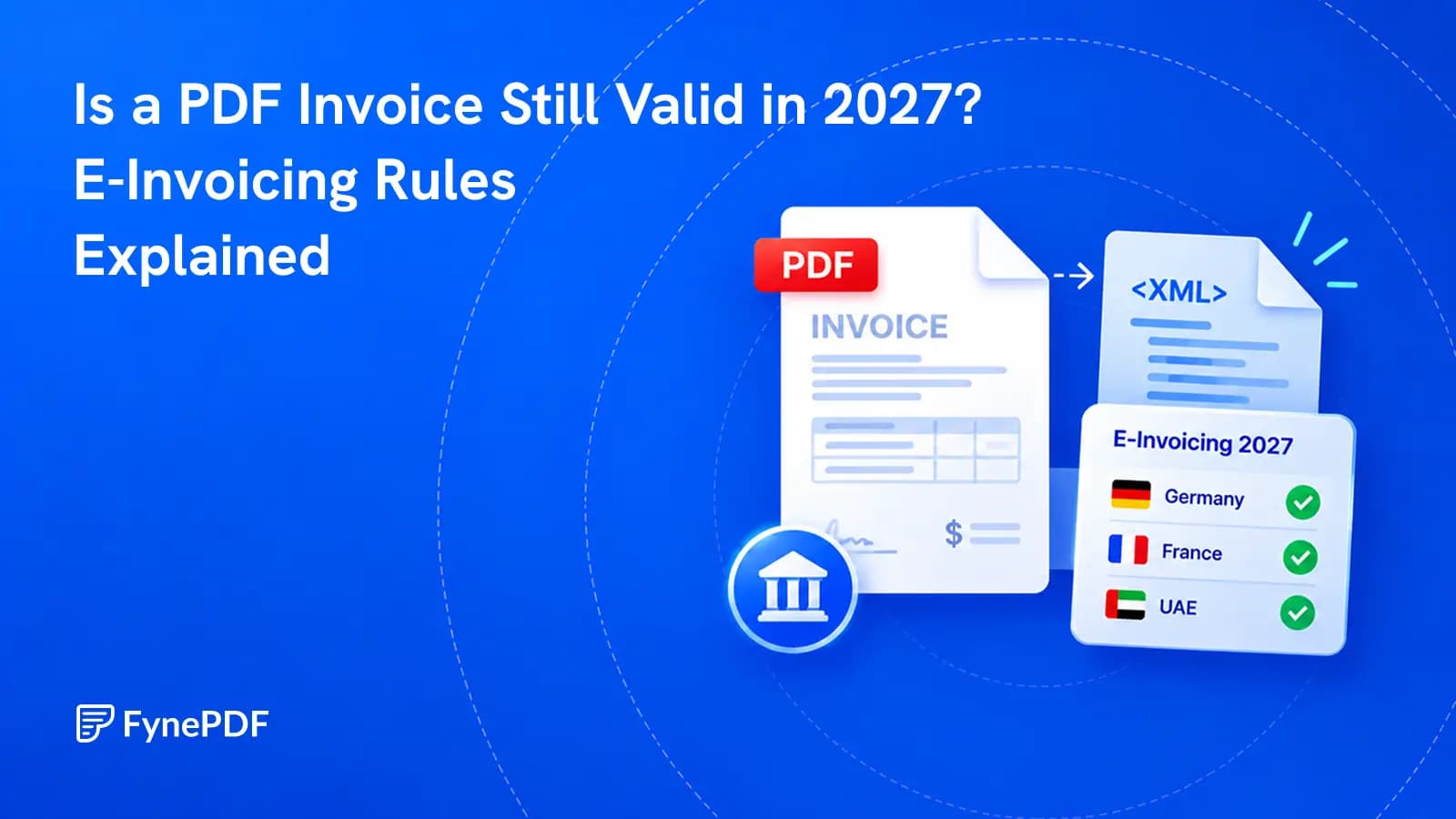
A PDF can still be readable and legally useful while failing a new e-invoicing requirement. The difference is structured data.